Trademark Office Action? What It Means and How to Respond
 By Nadine Deeb, Esq. · Published · 16 min read
You finally filed the trademark application — maybe for the name on your storefront, the brand you spent months building, or the company name already printed on packaging, contracts, and a website. Then a letter arrives from the USPTO saying your mark has been refused.
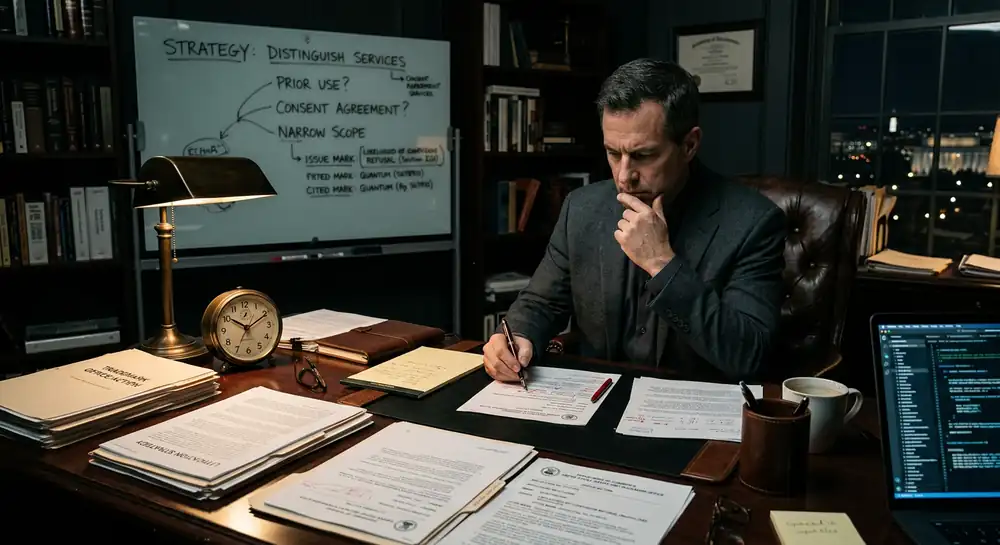
It cites statutes, regulations, prior registrations, specimens, or legal standards you have probably never had to think about. To most business owners it reads like a rejection, and the natural reaction is: is my application dead? Did I just lose the filing fee? Do I have to start over?
Usually, no.
That letter is called a trademark office action, and it is a normal part of USPTO examination. It can be serious, but it is not automatically the end of the application. Many office actions can be answered. Some can be fixed with amendments. Some require legal argument and evidence. What matters most is understanding what the examining attorney is asking for — and responding before the deadline.
Quick Answer: What Is a Trademark Office Action?
A trademark office action is a letter from a USPTO examining attorney identifying problems with a trademark application. For most applications, the USPTO must receive a response within three months from the office action issue date, although a single three-month extension may be available if requested on time. Madrid Protocol applications under Section 66(a) generally have six months to respond and cannot extend that deadline. Common refusals include likelihood of confusion under Section 2(d) and mere descriptiveness under Section 2(e)(1).
An Office Action Is a Letter, Not a Verdict
After you file, the USPTO assigns your application to an examining attorney. That attorney reviews it against the legal requirements for registration, searches for conflicting marks, and checks whether the application materials are complete and acceptable. If something needs to be addressed, the examining attorney issues an office action explaining the problem. See the USPTO’s guidance on responding to office actions.
Think of it as a structured legal conversation. The examining attorney is telling you what currently stands between your application and registration.
Some office actions raise administrative issues: the identification of goods or services is too broad, a disclaimer is required, or the specimen does not show proper use of the mark. Others raise substantive legal refusals, such as likelihood of confusion or mere descriptiveness. The document may not explain that distinction in business-friendly language, which is why applicants often misread every refusal as final.
It is not final simply because it is formal. But it is time-sensitive.
The Clock Is Shorter Than Many Business Owners Expect
This is the part that costs businesses their applications.
For most trademark applications, the USPTO must receive your response within three months from the issue date printed on the office action. Not three months from the day you opened the letter. Not three months from when you forwarded it to someone else. Not three months from when you finally had time to think about it. Three months from the issue date.
For many non-Madrid applications, you may request one three-month extension if the request is filed within the original three-month response period. If granted, the response deadline becomes six months from the office action issue date. A fee applies to the extension request, and because USPTO fees change periodically you should confirm the current amount on the USPTO fee schedule before filing. See also USPTO — Response time period.
There is one important exception: applications filed through the Madrid Protocol under Section 66(a) generally have six months to respond and cannot extend that deadline. See 37 C.F.R. § 2.62.
The practical effect is simple: if you set the letter aside intending to deal with it “next quarter,” you may already be out of time.
Received a USPTO office action?
The response deadline may be shorter than you think. We can review the refusal and walk you through your options.
Refusal One: Likelihood of Confusion
One of the most common substantive refusals is likelihood of confusion.
The legal basis is Section 2(d) of the Trademark Act, which bars registration of a mark that is so similar to an existing registered mark, for related goods or services, that consumers would likely be confused, mistaken, or deceived about the source. See 15 U.S.C. § 1052(d) and USPTO — Likelihood of confusion.
The trap is that the marks do not have to be identical. The goods or services do not have to be identical either. A founder may look at the cited registration and think, “that is not us.” The USPTO may still see a problem if the marks create a similar commercial impression and the goods or services are close enough that consumers could reasonably believe they come from the same source.
A likelihood-of-confusion response often focuses on issues such as:
- how the marks differ in appearance, sound, meaning, or overall commercial impression;
- whether the cited mark is weak because similar wording is used by many others;
- whether the goods or services are actually distinct in the marketplace;
- whether the trade channels and purchasers differ;
- whether amendments to the goods or services could reduce or remove the perceived overlap.
What usually does not answer the USPTO’s question is saying that you did not know about the other mark, that the other company has never complained, that you registered an LLC or corporation with a state agency, or that you own the matching domain name.
Those facts may matter for business planning, but they do not decide federal registrability. State business registration, domain ownership, and federal trademark registration are separate systems that answer different questions. If you are still deciding what to file, our guide on trademarks, trade names, and DBAs explains how those systems differ.
Refusal Two: Merely Descriptive
Another common refusal is that the mark is merely descriptive under Section 2(e)(1) of the Trademark Act. See 15 U.S.C. § 1052(e) and USPTO — Possible grounds for refusal of a mark.
A mark is merely descriptive if it immediately tells consumers something about an ingredient, quality, characteristic, function, feature, purpose, or use of the goods or services. The USPTO’s examples include terms like CREAMY for yogurt or WORLD’S BEST BAGELS for bagels.
This refusal frustrates business owners because descriptive names often feel like good marketing. They explain what the business does. They make the pitch easier. They may even help with search visibility.
But trademark law is not designed to let one business monopolize ordinary words that competitors need to describe their own goods or services. That is the tension: the words that are easiest to market are sometimes the hardest to protect.
The marks that tend to be strongest are the ones that require a small mental leap — coined words, arbitrary words applied to unrelated goods or services, or suggestive marks that hint at a quality or benefit without naming it directly. Our guide on how to trademark a business name covers how that strength is built at the naming stage.
There is also a harder line beyond descriptiveness. A term that has become the common name for the product or service category itself is generic. Generic terms cannot function as trademarks for those goods or services. If an office action characterizes a mark as generic rather than merely descriptive, that is a materially more difficult problem.
If Your Mark Is Called Descriptive, You May Still Have Options
A descriptiveness refusal is not automatically fatal. The right path depends on the mark, the goods or services, the evidence, and the business goal.
Option 1: Argue That the Mark Is Suggestive, Not Descriptive
Descriptiveness is often a judgment call, and the legal line between descriptive and suggestive can be contested. If consumers have to use imagination, thought, or perception to connect the mark to the goods or services, the mark may be suggestive rather than descriptive. A response may develop that argument using the wording of the mark, the nature of the goods or services, dictionary evidence, marketplace evidence, and examples of how similar terms are used.
Option 2: Claim Acquired Distinctiveness Under Section 2(f)
A descriptive mark may become registrable on the Principal Register if consumers have come to recognize it as identifying one source. This is called acquired distinctiveness, or secondary meaning. See USPTO — How to claim acquired distinctiveness under Section 2(f).
In some cases, an applicant may support a Section 2(f) claim with a verified statement of at least five years of substantially exclusive and continuous use in commerce. But that is not always enough. The more descriptive the mark is, the more evidence the USPTO may require, and highly descriptive terms often need more than a five-year-use statement.
Evidence may include sales history, advertising, customer declarations, unsolicited media coverage, market recognition, and the length and manner of use.
Option 3: Amend to the Supplemental Register
The Supplemental Register is a secondary federal register for marks that are capable of distinguishing goods or services but are not yet distinctive enough for the Principal Register. See 15 U.S.C. § 1091.
This can be a useful fallback. A Supplemental Register registration may allow use of the ® symbol, provide public notice of the registration, and create practical deterrence against later users. It does not provide all the benefits of the Principal Register, so the tradeoff should be understood before amending.
For some businesses the Supplemental Register is a strategic bridge. For others, it may be a sign that a stronger brand name should be considered before more money is spent building around a difficult mark.
New laws, before they catch you off guard.
Monthly. New Arizona, California, and Texas business-law changes, the deadlines attached to them, and what they mean in practice. No spam — unsubscribe anytime.
By subscribing you agree to receive emails from Accord & Shield Legal. This is general information, not legal advice.
Not Every Office Action Is a Substantive Refusal
Many office actions raise administrative or technical issues rather than major legal refusals. Common examples include:
- an identification of goods or services that is too broad, indefinite, or incorrectly classified;
- a required disclaimer of a descriptive or generic portion of the mark;
- a specimen that does not show the mark being used properly in commerce;
- an issue with the applicant name, entity type, or filing basis;
- a request for clarification or amendment.
These issues may be easier to fix, but they carry the same deadline. An office action that is easy to answer is still dangerous if ignored.
Not sure how this applies to your business? A short conversation with counsel can help identify the areas worth reviewing. We offer an initial consultation for businesses in Arizona, California, and Texas.
Schedule a Consultation →What a Strong Office Action Response Actually Contains
A strong response usually does four things.
1. It Addresses Every Issue Raised
Office actions often raise more than one issue. A response that argues against a likelihood-of-confusion refusal but ignores a required disclaimer or specimen issue may still leave the application unresolved. The first step is to inventory the office action from beginning to end: what is refused, what is required, what is optional, and what the consequences of amending versus arguing would be.
2. It Uses Evidence, Not Just Frustration
A business owner may understandably feel that the examining attorney “just does not get the brand.” But a successful response is not built on frustration. It is built on evidence and legal standards. Depending on the refusal, useful evidence may include third-party registrations or marketplace use, dictionary definitions, screenshots showing how terms are used in the industry, evidence about trade channels or purchaser sophistication, proof of actual use and consumer recognition, or amendments that clarify the real scope of the goods and services.
3. It Chooses Between Argument and Amendment
Sometimes the best answer is a legal argument. Sometimes the better move is an amendment. Narrowing an identification of goods or services may reduce overlap with a cited registration — but narrowing has consequences. You generally cannot broaden the identification later beyond the scope of what was filed, and a quick amendment can solve one problem while creating another if it no longer covers what the business actually sells.
4. It Stays Consistent With Reality
Statements to the USPTO matter. Claims about use, goods, services, dates, ownership, and distinctiveness must be accurate. A response should not overstate the business, exaggerate use, or make amendments that do not match what the applicant actually does. A trademark application is not only a form. It is a legal record.
What Happens If You Miss the Deadline
If the USPTO does not receive a timely response, the application generally goes abandoned.
Abandonment is not always permanent. If the failure to respond was unintentional, you may be able to file a petition to revive. The timing is short: the petition generally must be filed no later than two months after the issue date of the Notice of Abandonment. If you did not receive the notice, different timing rules may apply, but there is still an outside limit tied to the abandonment date shown in the USPTO’s electronic records. See USPTO — Reviving an abandoned application.
A petition to revive usually requires a statement that the delay was unintentional, a complete response to the original office action or other required action, and the required USPTO fee. Confirm the current fee on the USPTO fee schedule before filing.
The cost of abandonment is not only the fee. It may also be the filing date. If a competitor filed for a similar mark while your application sat abandoned, the lost time may matter more than the money.
What This Means If You Are Building a Brand
A trademark office action is not just a legal document. It is a business moment. It tells you whether the brand you chose is moving smoothly through federal review, whether the USPTO sees a conflict, whether the name is too descriptive, whether the application was drafted too broadly, or whether the evidence of use is not strong enough.
Open USPTO correspondence immediately. Calendar the deadline from the issue date. If you need time to gather evidence, discuss strategy, or request an extension, waiting can eliminate options.
Do not treat a refusal as the end. A refusal is not the same as a dead application. Likelihood-of-confusion and descriptiveness refusals can sometimes be answered with argument, evidence, amendment, or a registration strategy that fits the business goal.
Take descriptiveness seriously before filing. The strength of a mark is largely determined when the name is chosen. A clearance search and trademark-strength review before filing are often far less expensive than responding to a refusal after the brand has already launched.
Understand that the response is legal advocacy. A response is not simply a form. It is a legal submission to a federal agency. It should identify the applicable refusal, apply the correct legal standard, address each issue, and support the position with evidence where needed.
How Accord & Shield Legal Can Help
If you received a trademark office action, we can help you understand what the USPTO is asking for and what options remain. Depending on the office action, we can assist with:
- reviewing the office action and confirming the deadline;
- identifying whether the issues are administrative, substantive, or both;
- evaluating likelihood-of-confusion refusals;
- assessing descriptiveness, genericness, and acquired-distinctiveness options;
- preparing evidence and legal argument;
- considering amendments to goods and services;
- evaluating whether the Supplemental Register makes strategic sense;
- requesting an extension when appropriate and available;
- preparing a petition to revive if the application has gone abandoned;
- advising on whether a new filing or rebrand may be the better business decision.
We have seen the same pattern many times: a founder or business owner receives an official-looking refusal, assumes the brand is lost, and waits too long. The earlier you get advice, the more options you usually have. Our trademark practice page covers the full scope of that work.
Where This Fits in the Larger Trademark Picture
An office action is one point in a longer trademark process. The name you choose affects whether the USPTO sees the mark as strong or weak. The clearance work you do before filing affects whether conflicts are discovered early or after money has already been spent. The application strategy affects how broadly the mark may be protected. And after registration, maintenance filings are required to keep the registration alive. See USPTO — Trademark process overview.
If someone is already using a name close to yours, our guide on what to do when someone uses your business name covers the enforcement side. And if your business creates original content as well as brand assets, copyright registration works on a separate track from trademark.
If you have received an office action and are not sure what it is asking for, the most useful first step is a careful legal review of the actual refusal, requirements, deadlines, and available response paths.
The letter may feel like the end of the road. Often, it is not. But it is a deadline — and deadlines deserve attention.
Legal Sources Cited
- USPTO — Responding to office actions — guidance on what an office action is and how to reply.
- USPTO — Response time period — response deadlines and extension requests.
- USPTO — Possible grounds for refusal of a mark — the statutory bases examining attorneys rely on.
- USPTO — Likelihood of confusion — how the USPTO evaluates conflicting marks.
- USPTO — Acquired distinctiveness under Section 2(f) — evidence required to show secondary meaning.
- USPTO — Reviving an abandoned application — petition to revive requirements and timing.
- USPTO — Trademark process overview — the full examination and registration timeline.
- USPTO — Fee schedule — current filing, extension, and petition fees.
- 15 U.S.C. § 1052 — Trademark Act Section 2, including 2(d), 2(e), and 2(f).
- 15 U.S.C. § 1091 — the Supplemental Register.
- 37 C.F.R. § 2.62 — response periods, including the Madrid Section 66(a) exception.
Disclaimer
This article is provided by Accord & Shield Legal for general informational and educational purposes only. It is not legal advice and should not be relied on as legal advice for any specific business, application, mark, refusal, registration, or enforcement decision. Trademark law is fact-specific, and the correct strategy may depend on the mark, the goods or services, prior rights, the filing basis, evidence of use, jurisdiction, and the particular refusal at issue.
Reading this article, visiting this website, or contacting the firm through the website does not create an attorney-client relationship with Accord & Shield Legal or any of its attorneys. An attorney-client relationship is formed only after the firm confirms that it can represent you and you sign an engagement agreement. You should not send confidential or time-sensitive information until an attorney-client relationship has been established.
No representation is made that the information in this article is complete, current, or applicable to your specific circumstances. Prior results do not guarantee a similar outcome. If you have a trademark, contract, takedown, or infringement issue, consult qualified legal counsel before taking action.
Frequently Asked Questions About Trademark Office Actions
Is a trademark office action the same as a rejection?
No. A trademark office action is a letter from a USPTO examining attorney identifying issues that must be addressed before the application can proceed. Some office actions raise administrative issues that may be straightforward to fix. Others raise substantive refusals that require legal argument, evidence, amendment, or a change in strategy.
How long do I have to respond to a trademark office action?
For most applications, the USPTO must receive the response within three months from the office action issue date. In many non-Madrid applications, one three-month extension may be available if requested within the original response period. Madrid Protocol applications under Section 66(a) generally have six months to respond and cannot extend that deadline. Always check the office action itself and current USPTO guidance.
How much does a trademark office action extension cost?
A fee applies to a request for an extension of time to respond to a pre-registration office action, and it is charged per class. USPTO fees change periodically, so confirm the current amount on the USPTO fee schedule before filing rather than relying on a figure published elsewhere.
What is the most common reason a trademark is refused?
A common substantive refusal is likelihood of confusion under Section 2(d) of the Trademark Act. This applies when the USPTO believes the applied-for mark is too similar to an existing registered mark for related goods or services, such that consumers may believe both come from the same source.
Can I still protect a descriptive name?
Possibly. Options may include arguing that the mark is suggestive rather than descriptive, claiming acquired distinctiveness under Section 2(f), or amending to the Supplemental Register. The right path depends on the mark, the goods or services, the evidence, and the business goal.
What happens if I miss the office action deadline?
The application generally goes abandoned. If the delay was unintentional, it may be possible to file a petition to revive, but the timing is short and a fee applies. The bigger risk may be loss of the original filing date, especially if another party files for a similar mark while the application is abandoned.
Should I respond myself or hire a trademark attorney?
Some administrative office actions may be manageable for applicants who understand the USPTO requirements. Substantive refusals, including likelihood of confusion and descriptiveness refusals, often require legal argument, evidence, and strategic judgment. If the brand is important to the business, attorney review is usually worth considering before the response deadline.