Do You Really Own Your Company’s IP? The Assignment Trap
 By Nadine Deeb, Esq. · Published · Updated · 10 min read
Ask most founders whether their company owns its intellectual property and the answer is immediate: of course. We built it. We paid for it. It runs our business.
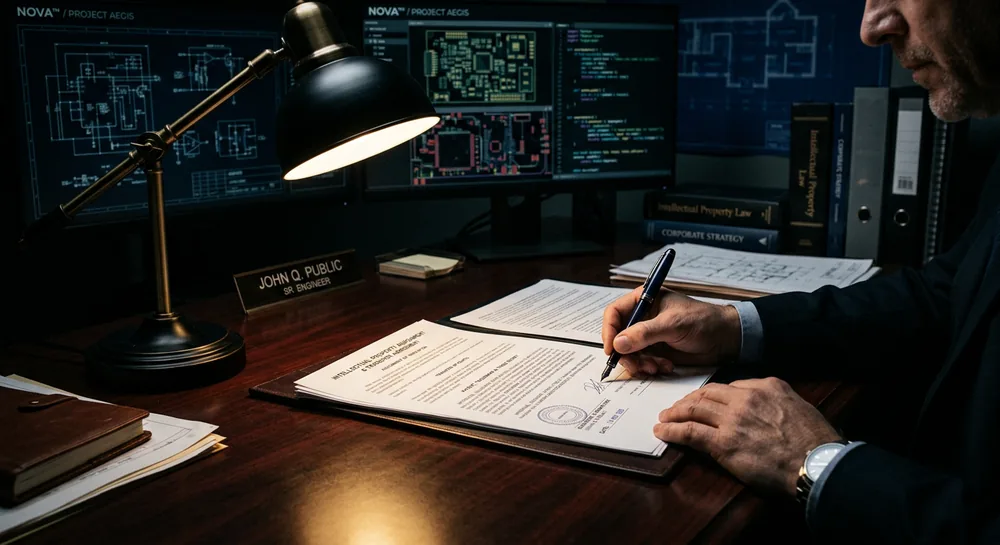
Then a financing, an acquisition, or a dispute arrives — and the question changes from “who built it?” to “who owns it, and can you prove it?” Those are different questions, and the second one is answered by documents, not by effort or intent.
At Accord & Shield Legal, we have seen companies discover late that a founder’s pre-formation code was never transferred, that a contractor who built the core product never signed an assignment, or that the “company’s” brand is registered to an individual. Every one of those gaps is cheaper to fix early — and hardest to fix at exactly the moment it matters most.
Quick Answer: Does My Company Own Its IP?
Only if ownership was actually transferred to or created in the company. Creation does not equal ownership. Founders, employees, contractors, agencies, and even AI-assisted workflows can produce valuable assets that legally belong to someone other than the company unless written assignments, work-made-for-hire coverage, or other transfer documents put ownership where everyone assumes it already is.
Creation Is Not Ownership
Copyright law starts from a simple default: ownership vests in the author. The U.S. Copyright Office explains that copyright exists automatically in original works of authorship once fixed, and that the author is generally the initial owner — see the Copyright Office’s What is Copyright? overview. Paying for the work, hosting it on company servers, or using it in the business does not by itself change that default.
That is why IP assignments exist: they move ownership from the person who created the asset to the company that needs to own it.
Founders: The Pre-Formation Gap
Many companies are built on work that predates the entity. A founder writes the prototype, designs the logo, drafts the content, or files a provisional patent application before the LLC or corporation exists. Whatever was created before formation belongs to the founder personally until it is assigned to the company — usually through a founder IP assignment or technology contribution agreement signed at or after formation.
This gap is one of the first things investors and acquirers look for, and it is the same gap that turns painful when a co-founder leaves or when a technical partner built the product on a handshake equity promise.
Employees: Work Made for Hire Is Narrower Than You Think
Employers often assume they automatically own everything employees create. The work-made-for-hire doctrine does cover works prepared by employees within the scope of employment — but the doctrine has limits. The Copyright Office’s Works Made for Hire (Circular 30) circular explains the two branches: employee works within the scope of employment, and specially commissioned works that fall into specific statutory categories and are covered by a signed written agreement.
The Supreme Court addressed who counts as an “employee” for these purposes in Community for Creative Non-Violence v. Reid, 490 U.S. 730 (1989), applying common-law agency factors rather than labels. The practical takeaway: side projects, work outside the job description, pre-employment creations, and inventions may fall outside the doctrine — which is why well-drafted employment agreements include confidentiality and invention-assignment provisions rather than relying on defaults.
Not sure whether your employment and contractor templates actually capture IP? A document review can confirm what the company owns today — and what needs a confirmatory assignment. We help companies in Arizona, California, and Texas close the gaps.
Review your IP assignments →Contractors: The Biggest Ownership Trap
Independent contractors are where most IP ownership problems live. A contractor is generally not an employee, so the employee branch of work made for hire does not apply. The commissioned-work branch only covers certain categories of works — and software often does not fit cleanly — so without a written assignment, the contractor may own the copyright in the very product the company paid for.
The safest structure for contractor agreements is belt and suspenders: work-made-for-hire language where applicable, plus a present assignment of all rights in the deliverables, plus waivers and cooperation obligations. If your developer, designer, agency, or freelancer relationships are documented by invoices and emails alone, treat that as an open ownership question — not a technicality.
“Hereby Assigns” vs. “Agrees to Assign”
Assignment wording matters more than most people expect. Courts have distinguished between present assignments (“hereby assigns”), which transfer rights immediately, and promises of future assignment (“agrees to assign”), which may require another step. The Federal Circuit treated that distinction as decisive in FilmTec Corp. v. Allied-Signal Inc., 939 F.2d 1568 (Fed. Cir. 1991), and the Supreme Court’s decision in Board of Trustees of the Leland Stanford Junior University v. Roche Molecular Systems, Inc., 563 U.S. 776 (2011), shows how competing assignment clauses can determine who ends up owning patent rights.
For business owners, the lesson is not to memorize case law — it is to have counsel review the actual assignment language in your templates before you rely on it.
Patents and Inventions
Patent rights initially belong to inventors. Companies acquire those rights through assignments, which should be recorded. The USPTO explains that patent owners can transfer ownership through an assignment and that assignments should be recorded with the USPTO’s Assignment Recordation Branch — see USPTO guidance on patent assignments. Employment agreements for technical roles should include invention-assignment provisions, subject to any state-law limits on assigning inventions created entirely on personal time and resources.
New laws, before they catch you off guard.
Monthly. New Arizona, California, and Texas business-law changes, the deadlines attached to them, and what they mean in practice. No spam — unsubscribe anytime.
By subscribing you agree to receive emails from Accord & Shield Legal. This is general information, not legal advice.
Trademarks and the Brand
Brand assets follow the same pattern. If a founder, agency, or affiliate registered the trademark or owns the domains and design files, the company may be using a brand it does not own. The USPTO explains that trademark ownership can be transferred through an assignment and recorded — see USPTO guidance on trademark assignments. Trademark transfers have their own rules — including that assignments generally must include the associated goodwill — so brand cleanup should be done deliberately, not with a generic form.
Where Ownership Gaps Surface
IP ownership problems rarely announce themselves early. They surface when the stakes are highest: an investor’s counsel asks for the chain of title during a financing; an acquirer’s diligence team asks for every assignment during a company sale; a departed contractor or founder claims ownership or demands payment; or the company tries to enforce rights it cannot prove it owns. In each case, the missing signature costs more than it would have at the start — sometimes in dollars, sometimes in leverage, sometimes in the deal itself.
Cleaning Up the Chain of Title
The good news: most gaps can be fixed. Common cleanup steps include founder technology-contribution or assignment agreements; confirmatory assignments from employees and contractors ratifying earlier transfers; updated employment and contractor templates with present-assignment language; trademark and patent assignments recorded with the USPTO; domain and account ownership transfers into the entity; and an IP register documenting what the company owns and how it acquired each asset.
Cleanup is easiest while relationships are good. A contractor who was paid fairly and is still friendly will usually sign a confirmatory assignment. The same contractor mid-dispute may see the missing signature as leverage. Coordinate the cleanup with the rest of your core startup documents so the fix holds.
Raising a round or heading toward a sale? A chain-of-title review before diligence starts turns IP gaps from a negotiating problem into a routine cleanup task.
Get a chain-of-title review →The Legal Framework Behind IP Ownership
Copyright law. Ownership vests in the author by default; companies acquire rights through employment (within limits), qualifying works made for hire, or written assignments. Owning the copyright is a separate question from being able to enforce it — see why registration decides your remedies.
Patent law. Inventors own inventions until assigned; assignment language and recording matter, and employment agreements should address inventions directly.
Trademark law. Ownership follows use and registration by the correct owner; transfers require assignments with goodwill and should be recorded.
Trade secret law. Protection depends on reasonable secrecy measures — confidentiality agreements, access controls, and policies — which is a different protection strategy than patenting, with different documentation.
Contract law. Assignments, licenses, contribution agreements, and confirmatory assignments are contracts; their wording, signatures, and timing decide what actually transferred.
How Accord & Shield Legal Can Help
We help startups, founders, and growing companies confirm and clean up IP ownership — founder and contractor assignments, employment and invention-assignment provisions, confirmatory assignments, trademark and patent assignment recording, chain-of-title reviews before financings and sales, and coordinating IP strategy with corporate documents, employment agreements, and deal preparation.
We have seen the same pattern many times: the company that fixes ownership early treats it as paperwork; the company that waits treats it as a crisis. The difference is usually a handful of signatures obtained at the right time.
Red Flags That Your IP Ownership Needs Review
Get legal review if a founder built the product before the entity existed and never signed an assignment; contractors or agencies created code, designs, or content without written IP terms; employment agreements lack invention-assignment and confidentiality provisions; trademarks, domains, or key accounts are held by an individual rather than the company; your templates say “agrees to assign” rather than “hereby assigns”; a contributor has left on bad terms; or a financing, acquisition, or enforcement action is on the horizon.
Final Thoughts
“We built it” is not the same as “we own it.” IP ownership is a documentation question, and the documents are inexpensive compared to the moments when they are missing. Confirm the chain of title now — founder contributions, employee agreements, contractor assignments, brand registrations — and the company’s most valuable assets will be there when a buyer, investor, or court asks for proof.
If you are not certain your company owns what it runs on, Accord & Shield Legal can help you find the gaps and close them.
This article is provided by Accord & Shield Legal for general informational purposes only. It is not legal advice, does not create an attorney-client relationship, and should not be relied upon as a substitute for advice from a qualified attorney who understands your specific facts, entity structure, agreements, intellectual property, employment relationships, jurisdiction, and business goals. IP ownership may involve copyright, patent, trademark, trade secret, contract, and employment issues, and outcomes depend on the documents and applicable law. Do not send confidential or privileged information unless and until an attorney-client relationship has been formally established in writing. Prior results do not guarantee a similar outcome.
Frequently Asked Questions
What is an IP assignment agreement?
An IP assignment agreement transfers ownership of intellectual property from the creator to the company. It is how businesses acquire clear ownership of code, content, designs, inventions, and other assets created by founders, employees, and contractors.
Doesn’t the company automatically own what employees create?
Not always. Employers may own certain works created by employees within the scope of employment, but the rules are narrower than most owners assume, and inventions, side projects, and pre-employment work may fall outside them.
Do contractors own the work they create for my company?
Often, yes — unless there is a written agreement assigning ownership. Independent contractors are generally treated differently from employees, and paying for the work does not by itself transfer copyright ownership.
What is a work made for hire?
A work made for hire is a legal category where the employer or commissioning party is treated as the author. For commissioned works from non-employees, the work must fall into specific statutory categories and be covered by a signed written agreement.
What does “hereby assigns” mean and why does it matter?
Present-assignment language like “hereby assigns” transfers rights immediately, while “agrees to assign” may only promise a future transfer. Courts have treated the difference as decisive in ownership disputes, so the wording matters.
What is a confirmatory IP assignment?
A confirmatory assignment documents or ratifies a transfer that should have happened earlier. Companies often use them to clean up chain-of-title gaps before a financing or sale.
When do IP ownership problems usually surface?
Most often during fundraising, acquisition due diligence, disputes with departing founders or contractors, and enforcement actions — the moments when clean ownership matters most.
Do I need a lawyer for IP assignments?
A lawyer can help draft assignment provisions, evaluate work-made-for-hire coverage, fix chain-of-title gaps, prepare confirmatory assignments, and coordinate IP ownership with employment, contractor, and corporate documents.