Trade Secrets vs. Patents: Which Protection Strategy Is Right for Your Business?
 By Nadine Deeb, Esq. · Published · Updated · 11 min read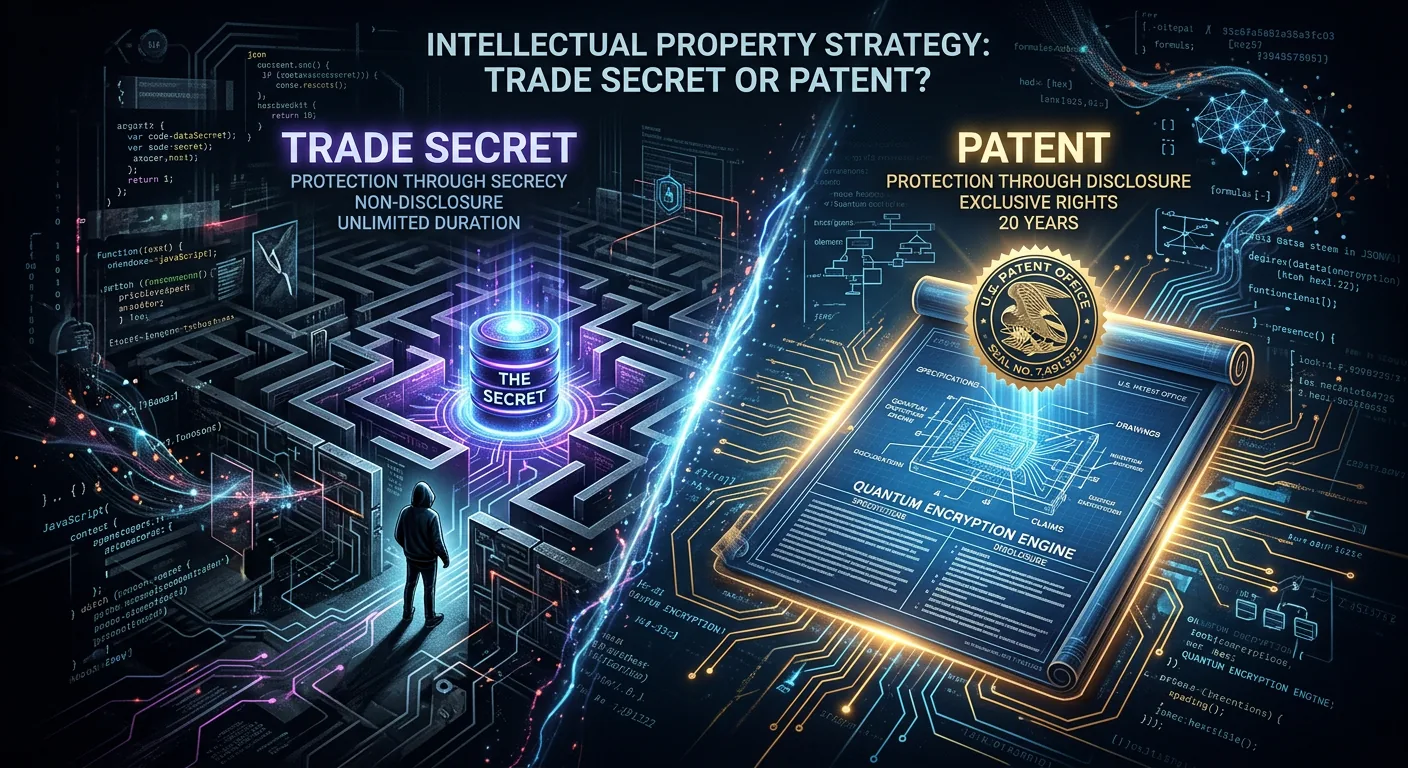
For many companies, the most valuable asset is not a building, product, or piece of equipment. It is information — and the choice between protecting it as a trade secret or through a patent can shape competitive advantage, investor story, litigation risk, and long-term value.
Source code, formulas, pricing models, manufacturing processes, client lists, vendor terms, product roadmaps, internal playbooks, research data — the know-how competitors would want if they could get it. The legal question is simple to ask but difficult to answer: should that information be protected as a trade secret, through a patent, or through a coordinated intellectual property strategy that uses both?
The answer matters because trade secrets and patents are built on opposite assumptions. A trade secret protects valuable information by keeping it confidential. A patent protects an invention by disclosing it to the public in exchange for a time-limited right to exclude others from making, using, selling, offering to sell, or importing the patented invention.
The Legal Framework: What Counts as a Trade Secret?
Under the federal Defend Trade Secrets Act of 2016, trade secret protection can apply to many types of business, technical, economic, and financial information if two core requirements are met: (1) the owner has taken reasonable measures to keep the information secret, and (2) the information derives independent economic value from not being generally known or readily ascertainable by others who could obtain economic value from its disclosure or use.
That legal standard is practical, not theoretical. A company cannot simply label information “confidential” and assume it is protected — courts look at whether the business actually treated the information like a secret. In Oakwood Laboratories LLC v. Thanoo, 999 F.3d 892 (3d Cir. 2021), the Third Circuit emphasized that trade secret claims require enough specificity to identify the alleged secret and connect it to the alleged misappropriation — a useful reminder that businesses should be able to explain what the trade secret is, why it has value, and how it was protected. And in InteliClear, LLC v. ETC Global Holdings, Inc., 978 F.3d 653 (9th Cir. 2020), the Ninth Circuit recognized that trade secrets may exist in a system, database, or compilation when the owner can identify the protected information with sufficient detail and show it is not generally known.
Depending on the facts, trade secrets may include:
- source code and software architecture;
- formulas, recipes, chemical compositions, or manufacturing processes;
- customer lists and non-public purchasing history;
- pricing models, margins, and vendor terms;
- internal sales scripts, onboarding systems, or operating procedures;
- machine learning training data, prompts, workflows, or model-tuning methods;
- product roadmaps, research data, or unreleased designs; and
- confidential business plans, acquisition targets, or go-to-market strategies.
But the protection depends on the company’s conduct. If the information is broadly shared, poorly controlled, posted publicly, disclosed without confidentiality obligations, or easily reverse engineered, trade secret protection may be weakened or lost.
The Legal Framework: What Does a Patent Protect?
A patent protects an invention that satisfies the requirements of U.S. patent law — at a high level, patent-eligible subject matter, novelty, non-obviousness, and a sufficient written disclosure, under the modern Patent Act as amended by the Leahy-Smith America Invents Act. The patent bargain is disclosure in exchange for exclusion: if the invention qualifies, the owner receives a limited right to exclude others from practicing the claimed invention — even if a competitor independently develops the same invention later.
That is a major difference from trade secret law, which generally protects only against improper acquisition, disclosure, or use. It does not give the owner a monopoly against independent development or lawful reverse engineering.
The U.S. Supreme Court has repeatedly recognized the policy balance between secrecy, disclosure, innovation, and public access. In Kewanee Oil Co. v. Bicron Corp., 416 U.S. 470 (1974), the Court held that state trade secret protection is not preempted by federal patent law — the two systems can coexist. In Bonito Boats, Inc. v. Thunder Craft Boats, Inc., 489 U.S. 141 (1989), the Court explained that federal patent law reflects a balance between encouraging innovation and preserving public access to unpatented ideas and designs. And in Alice Corp. Pty. Ltd. v. CLS Bank International, 573 U.S. 208 (2014), the Court held that implementing an abstract idea on a generic computer does not automatically make it patent eligible under 35 U.S.C. § 101 — a decision with real consequences for software, fintech, AI, and data-driven businesses, where patent eligibility must be assessed carefully before relying on patents as the primary protection strategy.
Trade Secrets vs. Patents: Key Business Differences
| Issue | Trade Secret | Patent |
|---|---|---|
| Core strategy | Keep valuable information confidential | Disclose the invention publicly in exchange for exclusive rights |
| Duration | Potentially indefinite, as long as secrecy is maintained | Limited statutory term, subject to patent rules and maintenance requirements |
| Disclosure | Public disclosure can destroy or weaken protection | Disclosure is part of the patent bargain |
| Independent development | Generally no protection if a competitor independently develops or lawfully reverse engineers | Can protect against later independent development if valid and infringed |
| Best suited for | Information that can realistically remain secret | Inventions that can be claimed, disclosed, and enforced |
| Risk points | Weak internal controls, employee departures, vendor leakage, public disclosure | Patent eligibility, prior art, prosecution cost, public design-around risk |
The USPTO similarly explains that trade secret protection and patent protection can complement each other, and that the decision depends on business considerations — while identifying a key patent advantage: patents may protect against independent discovery, whereas trade secret protection does not.
When Trade Secret Protection May Be the Better Fit
Trade secret protection may be a strong option when the information:
- is not easily reverse engineered from the final product;
- can be kept confidential through real operational controls;
- has value because competitors do not know it;
- may not satisfy patent eligibility, novelty, or non-obviousness requirements;
- would lose value if disclosed publicly;
- changes quickly, making patent prosecution too slow or impractical; or
- supports the business internally rather than appearing in a finished product.
For example, a company may choose trade secret protection for internal pricing algorithms, manufacturing parameters, proprietary training data, customer segmentation logic, or vendor negotiation playbooks. These assets may be extremely valuable, but public disclosure through a patent application could teach competitors too much.
Deciding how to protect your innovation? We help businesses build layered IP strategies across Arizona, California, and Texas.
Schedule a Consultation →When Patent Protection May Be the Better Fit
Patent protection may be more appropriate when:
- the invention can be reverse engineered once the product is released;
- the company wants protection against independent development;
- the invention is central to fundraising, licensing, acquisition value, or market exclusivity;
- the company can describe and claim the invention without giving away unrelated business secrets;
- the expected commercial life of the invention justifies the cost and timeline; or
- public disclosure is acceptable because exclusivity is more valuable than secrecy.
Patent protection can be especially important where a competitor could quickly inspect a product, copy the technical solution, or develop the same invention independently. In those situations, secrecy may not be enough.
New laws, before they catch you off guard.
Monthly. New Arizona, California, and Texas business-law changes, the deadlines attached to them, and what they mean in practice. No spam — unsubscribe anytime.
By subscribing you agree to receive emails from Accord & Shield Legal. This is general information, not legal advice.
The Strategic Mistake: Treating This as an Either/Or Decision
The strongest companies often do not ask, “trade secret or patent?” They ask, “which parts of our innovation should be disclosed, which parts should stay confidential, and what contracts and controls support that strategy?” A single product may include both patentable inventions and trade secrets:
- a company may patent a device architecture while keeping manufacturing tolerances confidential;
- a software company may seek patent protection for a technical system while protecting training data, scoring logic, and deployment workflows as trade secrets;
- a food, beverage, supplement, or cosmetics company may keep formulas, supplier relationships, and process refinements confidential while using trademarks and contracts to protect brand and distribution value; and
- a medical technology company may patent a device or method while keeping test data, vendor specifications, and commercialization plans confidential.
The legal framework supports this combined approach: Kewanee Oil confirms that trade secret law coexists with the federal patent system, and the USPTO likewise states that trade secret protection complements patent protection.
A Practical Decision Framework for Founders and Business Owners
1. Can the information realistically be kept secret?
If it will be visible in the product, disclosed to customers, shared with many vendors, or easily reverse engineered, patent protection may be more reliable than secrecy.
2. Does the information have value because competitors do not know it?
Trade secret law protects information that derives economic value from not being generally known or readily ascertainable. If the value depends on secrecy, build the controls before a dispute arises.
3. Would patent disclosure help or hurt the business?
A patent application may eventually publish technical details. That disclosure may be worth it if the patent creates enforceable exclusivity — and harmful if it teaches competitors how to compete around your advantage.
4. Is the invention likely patent eligible?
For software, automation, AI, fintech, and business-method inventions, patent eligibility should be evaluated carefully. Alice remains a key Supreme Court decision limiting patents that merely apply abstract ideas using generic computer implementation.
5. What will investors, acquirers, partners, or licensees expect?
Investors and buyers often want a coherent IP story: who owns the IP, what is protected, what is confidential, what has been disclosed, which employees or contractors assigned rights, and whether any third-party claims exist — questions that surface fast in M&A diligence.
6. Are the company’s contracts aligned with the IP strategy?
Trade secret protection often depends on contracts and operations: NDAs, employee confidentiality agreements, contractor IP assignments, vendor restrictions, data access rules, invention assignment agreements, and exit procedures.
Reasonable Measures: What Companies Should Do Before There Is a Problem
A trade secret program should be built before a breach, employee departure, investor diligence process, or lawsuit. Companies should consider:
- written confidentiality policies;
- employee, contractor, vendor, and advisor NDAs;
- invention assignment and work-made-for-hire language where appropriate;
- role-based access to sensitive systems;
- password, encryption, and multi-factor authentication controls;
- clean onboarding and offboarding procedures;
- restrictions on downloads, personal devices, and external storage;
- document labels for confidential and trade secret materials;
- vendor and data-room access controls;
- internal training on confidential information handling; and
- periodic audits of who has access to core business information.
The point is not paperwork for its own sake. The point is evidence. If a company later claims information was a trade secret, it should be able to show that it acted consistently with that claim.
Common Red Flags That Can Weaken Trade Secret Protection
Businesses often create avoidable risk when they:
- disclose sensitive information before an NDA is signed;
- use generic confidentiality templates that do not match the business model;
- fail to obtain IP assignments from founders, contractors, or developers;
- allow employees to store company information in personal email or cloud accounts;
- give vendors broad access without contractual limits;
- publish too much technical detail in marketing materials, pitch decks, or demos;
- fail to separate patent-disclosed information from confidential know-how;
- neglect exit interviews and device return procedures; or
- cannot identify what specific information they claim is secret.
These issues often surface during financing, M&A diligence, partnership negotiations, employment disputes, and competitor conflicts.
How Accord & Shield Can Help
Accord & Shield helps businesses protect the ideas, information, contracts, and commercial relationships that create enterprise value. For companies evaluating trade secrets vs. patents, we can help by:
- identifying which business assets may qualify for trade secret protection;
- coordinating with registered patent counsel where patent prosecution or patentability analysis is needed;
- drafting and updating NDAs, confidentiality agreements, invention assignment agreements, contractor agreements, vendor agreements, licensing terms, and employment-related IP provisions;
- reviewing whether internal confidentiality practices support trade secret protection;
- creating founder, employee, contractor, and vendor IP ownership frameworks;
- preparing companies for investor, buyer, or partner diligence;
- helping businesses avoid accidental disclosure of valuable information; and
- developing contract strategies for software, AI, data, licensing, and commercialization relationships.
The goal is not merely to “have an NDA.” The goal is to build an IP protection system that matches the company’s technology, revenue model, workforce, vendors, investors, and exit strategy.
Bottom Line
Trade secrets and patents protect innovation in very different ways. Trade secrets depend on secrecy, control, and disciplined business practices. Patents depend on disclosure, claim scope, patentability, and enforceability. For many companies, the right answer is a layered strategy: patent what should be publicly claimed, keep sensitive know-how confidential, and use contracts and internal controls to preserve ownership and value.
If your company relies on proprietary information, source code, processes, customer data, formulas, product plans, AI workflows, vendor terms, or other confidential know-how, now is the time to evaluate whether your legal documents and business practices actually protect those assets.
Frequently Asked Questions
Can I protect the same thing with both a patent and a trade secret?
Not the same aspect — a patent requires public disclosure, which destroys secrecy. But a company can patent one part of a product while keeping another part (like an algorithm or process) as a trade secret. The two strategies often work together across different elements of a technology.
What happens to a trade secret if a competitor figures it out independently?
Trade-secret protection only stops others from using information they obtained improperly. If a competitor independently develops or legitimately reverse-engineers the same information, you generally have no claim — which is a key reason patents matter for innovations that can be reverse-engineered.
Do I need to register a trade secret?
No. Trade-secret protection is automatic and requires no application or filing. But it only holds if you take reasonable steps to keep the information confidential — confidentiality agreements, access controls, and clear policies. Without those measures, the protection can evaporate.
This article is for general informational purposes only and does not constitute legal advice. Reading this article or contacting Accord & Shield through this website does not create an attorney-client relationship. Trade secret, patent, contract, employment, and intellectual property issues are fact-specific and may vary based on the applicable jurisdiction, industry, documents, disclosures, parties, and timing. Accord & Shield does not provide patent prosecution services unless expressly agreed in a signed engagement agreement, and patent-related matters may require coordination with registered patent counsel. Prior results do not guarantee a similar outcome.