Can You File a Trademark Yourself? Yes — But Here Is What Can Go Wrong
 By Nadine Deeb, Esq. · Published · 11 min read
You can file a federal trademark application yourself. The USPTO permits many applicants to do so, the form is online, and the process can look straightforward. What the form does not tell you is that submitting an application is not the same thing as obtaining a registration.
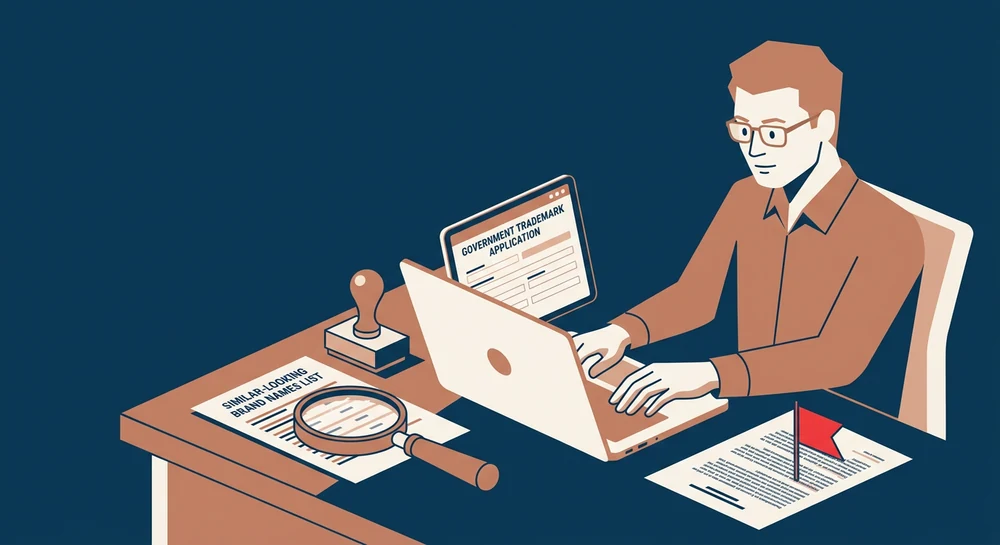
The USPTO does not guarantee that an application will register. Filing fees are generally not refundable, even if the application does not register. And applications can be refused for legal reasons that are not obvious from the form itself.
That does not mean every trademark application requires a lawyer. Some simple applications may be reasonable to file without counsel. But if the mark matters to the business, the better question is not “Can I file this myself?” It is “What could prevent this application from registering, and can those risks be addressed before filing?”
Quick Answer: Can You File a Trademark Without a Lawyer?
Yes, if you are domiciled in the United States. The USPTO does not require U.S.-domiciled applicants to be represented by an attorney. Foreign-domiciled applicants and registrants must have a U.S.-licensed attorney represent them. See USPTO — Do I need an attorney?. Filing without counsel is permitted, but the USPTO may still refuse registration based on issues such as likelihood of confusion, descriptiveness, specimen problems, or problems with the identification of goods and services — and filing fees are generally not refundable.
Filing Is Not the Same as Registration
This is the distinction that catches most first-time filers.
Paying the fee and submitting the form starts an examination. It does not end one. After filing, the application is assigned to a USPTO examining attorney who reviews it against the legal requirements for registration, searches for conflicting marks, and checks whether the application materials are acceptable. If something needs to be addressed, the examining attorney issues an office action.
A business that assumes the mark is “registered” the day it files may spend the following year building signage, packaging, and customer recognition around a name that is still under examination — and it may not register at all.
Why the USPTO Form Is Not the Hard Part
For many applicants, the form itself is not the hardest part. The difficult issues arise before and during filing, and most of them are decisions rather than data entry.
By the time you reach the form, several choices have usually already been made: what the mark will be, what it will cover, whether you are already using it, and what you will submit to prove that use. Those choices determine whether the application can succeed. The form simply records them.
That is why a clean, correctly completed application can still be refused. Nothing was typed wrong. The underlying decisions carried risk that was never evaluated.
What the USPTO Itself Says About Hiring an Attorney
This does not have to be a law firm’s argument. The USPTO publishes its own guidance on the question, and it is worth reading directly.
The agency states that if you are domiciled in the United States you are not required to have an attorney — and then adds: “Even if you’re not required to hire a U.S.-licensed attorney, consider whether or not you should. Be ready to act as your own attorney if you don’t hire one.”
Among the benefits the USPTO lists are conducting a trademark clearance search before an application is filed, preparing the application accurately, responding to legal correspondence from the USPTO, providing legal advice about the mark, enforcing and maintaining trademark rights, and shielding applicants from fraudulent solicitations. The agency also notes that attorney fees are an added cost, but that “in the long run, hiring an attorney may save you money.” See USPTO — Why hire a private trademark attorney.
The USPTO also draws a distinction that many business owners do not know exists. On the same guidance, the agency writes: “There are numerous companies that state they will help you file your application. Some of these companies may offer legitimate services; others do not. Be aware that trademark filing companies are not the same as law firms.” The USPTO states that it does not endorse the use of these filing companies, and publishes separate guidance on recognizing misleading notices and solicitations.
That is a meaningful difference. A non-lawyer filing service may be able to help submit a form. But form submission is not the same as legal advice about whether the mark is registrable in the first place.
Thinking about filing a trademark application?
We can help assess clearance risks, filing basis, and application issues before you pay filing fees that are generally not refundable.
Common Reasons Trademark Applications Run Into Trouble
The USPTO publishes a list of common problems applicants encounter. In practice, most of what goes wrong falls into a handful of categories.
- Likelihood of confusion. The examining attorney concludes the mark is too similar to an existing registered mark for related goods or services. Marks do not have to be identical to conflict, which is why an identical-match search on the USPTO database is not a clearance search. See USPTO — Why search for similar trademarks.
- Mere descriptiveness. A name that plainly describes the product or service may be refused. This one is common because a descriptive name is often good marketing — it tells customers exactly what you do. The USPTO explains the spectrum in its guidance on strong trademarks.
- Identification of goods and services. Too broad can draw an objection. Too narrow may leave important protection outside the application. This wording generally cannot be expanded after filing. See USPTO — Goods and services.
- Filing basis. Use in commerce and intent to use carry different requirements, deadlines, and evidence obligations. See USPTO — Application filing basis.
- Specimen problems. A specimen that does not show the mark used in the required way can draw a refusal even when everything else is correct. See USPTO — Drawings and specimens.
- Missed response deadlines. In most applications, the USPTO must receive a response within three months of the office action issue date, although an extension may be available for a fee. Madrid applications have different timing. See USPTO — Response time period.
None of these is obscure to a trademark practitioner. All of them are invisible on the form.
New laws, before they catch you off guard.
Monthly. New Arizona, California, and Texas business-law changes, the deadlines attached to them, and what they mean in practice. No spam — unsubscribe anytime.
By subscribing you agree to receive emails from Accord & Shield Legal. This is general information, not legal advice.
What an Abandoned Application Actually Costs
The filing fee is the smallest part.
USPTO filing fees are generally not refundable, even if the application does not register. Current amounts are published on the USPTO fee information page, and they change periodically.
The more significant issue is the filing date. A federal application can establish an important priority position if it proceeds to registration. If the application is abandoned, that filing-date advantage may be lost. If a competitor files for a similar mark in the meantime, the priority analysis can become more difficult and more expensive. In some circumstances an abandoned application may be revived — see USPTO — Reviving an abandoned application — but the timing is short and a fee applies.
The third cost is everything already built around the name. Signage, packaging, a website, business cards, a social presence, and customer recognition. A business that learns eighteen months in that its name may not be registrable has to choose between fighting for it and starting over.
Not sure how this applies to your business? A short conversation with counsel can help identify the areas worth reviewing. We offer an initial consultation for businesses in Arizona, California, and Texas.
Schedule a Consultation →When Filing Yourself May Be Reasonable
Sometimes it is, and an article that claims otherwise is not being straight with you.
Filing without counsel may be reasonable for a simple, low-risk application: a distinctive coined mark, one class, goods or services already being sold under the mark, no concerning search results, and a straightforward specimen. If that describes your situation and the brand is not central to the business, the do-it-yourself path is a defensible choice.
The USPTO also maintains information on what a trademark application costs and offers access to free and reduced-price legal services for applicants who qualify.
When Counsel Is Worth Considering
The calculus changes when any of the following is true:
- The brand is important to the business, and losing the name would be disruptive.
- The mark is descriptive or suggestive rather than coined.
- A search turns up marks that look or sound similar, even in a different industry.
- You need protection across multiple classes.
- You are filing on an intent-to-use basis rather than actual use.
- The specimen is not straightforward — software, services, and digital products often are not.
- An office action has already issued.
Trademark counsel can help evaluate registrability, clearance risks, filing basis, goods and services descriptions, and specimen issues before an application is submitted. That is work done in advance of the fee, not after the refusal.
Trademark Registration Is Federal
One point that is widely misunderstood: federal trademark applications are filed with and examined by the USPTO, not by any state.
Practically, that means a business generally does not need local counsel in its own city for federal USPTO trademark prosecution. Many businesses work with federal trademark counsel outside their own city or state for these matters. It is worth knowing, because business owners often assume they need a lawyer down the street and narrow their options unnecessarily.
State-law questions are different, and a trade name or state registration is not the same thing as a federal trademark. Our guide on the difference between a trademark, a trade name, and a DBA covers that distinction.
How Accord & Shield Legal Can Help
Our of counsel trademark attorney assists businesses with federal trademark applications and USPTO office actions. Depending on the matter, that can include:
- clearance searching and an assessment of how registrable a proposed mark may be
- selecting and drafting the identification of goods and services
- determining the correct filing basis and preparing the application
- reviewing specimen and use-in-commerce questions
- responding to office actions, including likelihood-of-confusion and descriptiveness refusals
- post-registration maintenance filings
We do not promise that any application will register. No firm can. What we can do is evaluate the risks before the fee is paid, and give you a clear read on whether the filing is worth making as drafted.
Where This Fits in the Larger Trademark Picture
Choosing a name, clearing it, filing it, and defending it are separate stages, and the decisions compound. Our guide on how to trademark a business name covers the selection and filing side. If you have already received a refusal, what a USPTO office action means and how to respond walks through the deadlines and options. If someone else is already using a name close to yours, what to do when someone uses your business name covers enforcement. And if you are still at the idea stage, protecting a business idea explains what trademark does and does not cover.
You can see the full scope of our trademark services as well.
Legal Sources Cited
- USPTO — Do I need an attorney? — representation requirements and the foreign-domicile rule.
- USPTO — Why hire a private trademark attorney — the agency’s own list of what counsel does.
- USPTO — Caution: misleading notices — recognizing solicitations and filing-company offers.
- USPTO — Common problems — frequent issues that delay or defeat applications.
- USPTO — Why search for similar trademarks — why clearance is more than an exact-match lookup.
- USPTO — Strong trademarks — the distinctiveness spectrum, from generic to fanciful.
- USPTO — Goods and services — how the identification is drafted and why it is hard to expand.
- USPTO — Application filing basis — use in commerce compared with intent to use.
- USPTO — Drawings and specimens — what an acceptable specimen must show.
- USPTO — Response time period — office action deadlines, extensions, and Madrid timing.
- USPTO — Reviving an abandoned application — petition to revive requirements and timing.
- USPTO — How much does it cost — application costs and access to reduced-price services.
- USPTO — Trademark fee information — current fees, which change periodically.
- USPTO — Trademark process overview — the full examination and registration timeline.
Disclaimer
This article is for general informational purposes only and does not constitute legal advice. Reading this article does not create an attorney-client relationship with Accord & Shield Legal or any attorney affiliated with the firm.
Trademark law, USPTO rules, filing requirements, fees, deadlines, and procedures can change, and the information in this article may not reflect the most current legal developments or agency guidance. Trademark rights and application strategy depend on the specific mark, goods or services, use history, search results, USPTO record, and other facts.
If you have questions about a specific trademark application, office action, or brand issue, consult qualified trademark counsel. Prior results do not guarantee a similar outcome. You should not send confidential or time-sensitive information until an attorney-client relationship has been established.
Frequently Asked Questions About Filing a Trademark Yourself
Can I file a trademark application myself?
Yes. The USPTO permits many applicants to file without an attorney. If you are domiciled in the United States, you are not required to have one. But filing an application is not the same as obtaining a registration. Trademark applications can involve legal issues that are not obvious from the form, including clearance, registrability, filing basis, goods and services descriptions, and specimen requirements.
What are common reasons a trademark application is refused?
Likelihood of confusion with an existing registered mark is a common substantive ground for refusal. Mere descriptiveness is another. Both can sometimes be addressed, but both are easier to evaluate before filing than after an office action has issued.
Do I lose my filing fee if my application is refused?
USPTO filing fees are generally not refundable. The larger risk is that an abandoned application may lose the benefit of its filing date. If another party files for a similar mark in the meantime, the priority analysis may become more difficult.
Does my trademark attorney need to be in my state?
For federal USPTO trademark matters, not necessarily. Federal trademark applications are filed with and examined by the USPTO. Many businesses work with federal trademark counsel outside their own city or state for USPTO prosecution matters.
I already filed and received a refusal. Is it too late?
Usually not. A refusal letter is called an office action, and many office actions can be answered if the response is filed on time. In most applications, the USPTO must receive a response within three months of the office action issue date, although an extension may be available for a fee. Madrid applications have different timing.