Can You Fire an Employee for a Social Media Post?
 By Nadine Deeb, Esq. · Published · Updated August 5, 2026 · Last legally reviewed August 5, 2026 · 10 min read
An employee’s social media post may justify discipline in some situations, but firing someone over online conduct can create legal risk. Employers should review whether the post involves protected concerted activity, discrimination complaints, retaliation, harassment, confidentiality, off-duty conduct, or inconsistent enforcement before making a termination decision.
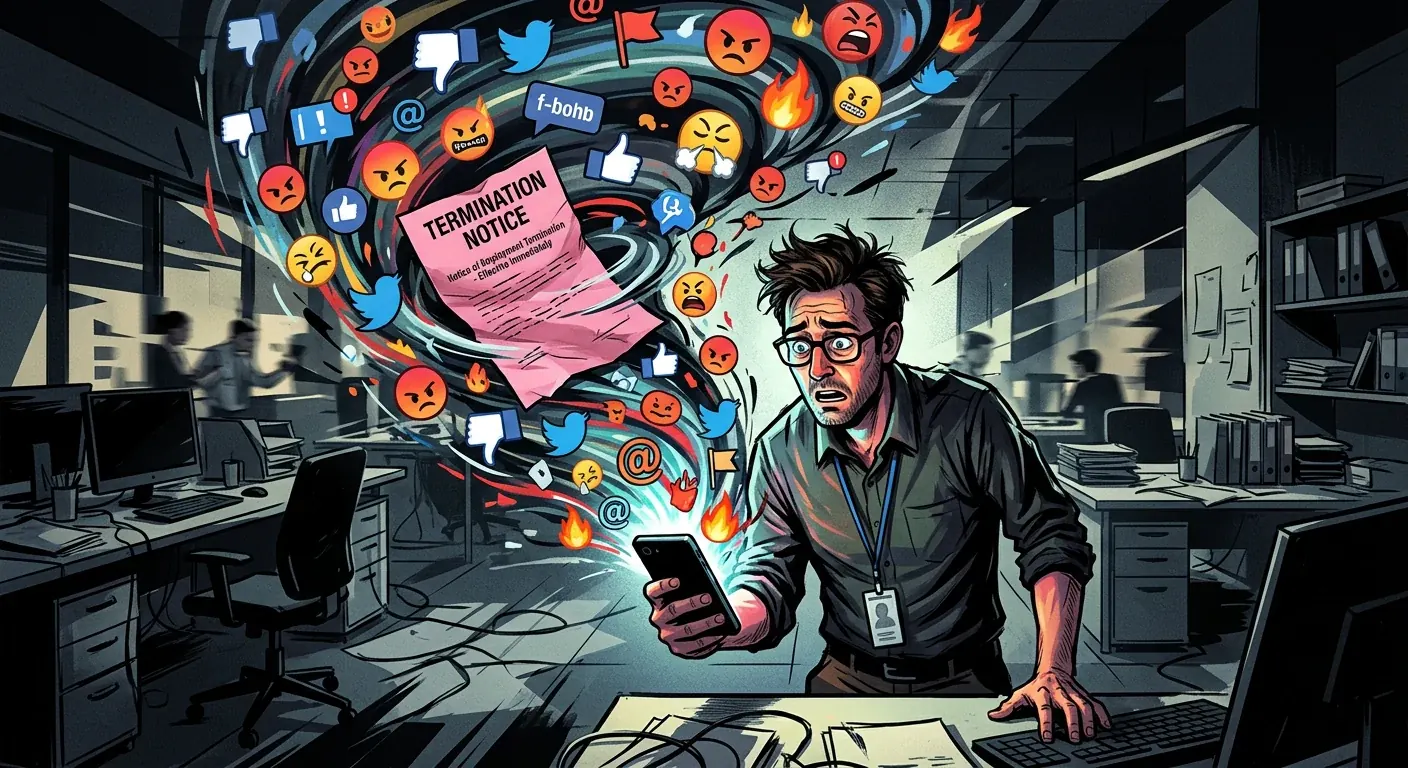
Introduction
Social media moves fast. A post can go viral in minutes, customers can react immediately, and employers may feel pressure to respond before the situation gets worse.
But firing an employee for a social media post is not always simple.
Sometimes an employee’s online conduct may justify discipline or termination. Other times, a post may involve legally protected activity, complaints about working conditions, discrimination concerns, retaliation risk, privacy issues, or state-law protections. The safest response is usually not an emotional one. It is a documented, consistent, legally reviewed decision.
At Accord & Shield Legal, we have seen how quickly social media issues can become employment disputes. A business may think it is protecting its reputation, but if the termination is rushed or inconsistent, the employer may face claims for retaliation, discrimination, wrongful discharge, unfair labor practices, or policy violations.
Before firing an employee over a post, employers should pause, preserve evidence, review the policy, analyze the legal risks, and speak with counsel when needed.
Quick Answer: Can You Fire an Employee for a Social Media Post?
Sometimes. Employers may be able to discipline or terminate an employee for social media posts that violate lawful workplace policies, disclose confidential information, threaten coworkers, harass others, damage the business, or conflict with job duties. But employers should be careful if the post discusses wages, hours, working conditions, discrimination, harassment, safety, retaliation, union activity, or other protected rights. The correct response depends on the facts, applicable law, company policy, and how similar situations have been handled.
Start With the Content of the Post
Not every offensive, embarrassing, or unpopular post creates the same legal risk.
Before acting, identify what the post actually says and does. Is it:
- A complaint about pay, scheduling, management, safety, or working conditions?
- A complaint about discrimination, harassment, or retaliation?
- A threat or violent statement?
- Harassment of a coworker, customer, or vendor?
- Disclosure of confidential business information?
- Disclosure of customer, patient, client, or employee information?
- A political or personal opinion posted off duty?
- A post using the company’s name, logo, uniform, or location?
- A post that appears to speak on behalf of the company?
- A post promoting the company’s products or services?
- A post that violates a clear written policy?
The legal analysis often turns on the details.
Facing this decision right now?
The answer depends on your state, your policy, and what was actually posted.
Preserve Evidence Before It Disappears
Social media content can be deleted, edited, hidden, or taken out of context. Before making a decision, preserve:
- Screenshots of the post
- Date and time
- Platform
- Comments and replies
- Whether coworkers engaged with the post
- Whether customers or clients responded
- The employee’s public profile information
- Any related workplace complaints
- Relevant policies
- Prior discipline records
- Communications with the employee
- Evidence of business impact
Avoid relying on rumors or incomplete screenshots. If the post may become part of a dispute, context matters.
Watch for Protected Concerted Activity
One of the biggest risks involves protected concerted activity under the National Labor Relations Act.
The National Labor Relations Board explains that employees may use social media to discuss work-related issues, including pay, benefits, and working conditions, with coworkers. Such activity may be protected when employees act together or seek to initiate group action. Mere individual griping may not be enough.
This protection can apply even in non-union workplaces.
Examples of posts that may require careful review include posts about:
- Low pay
- Overtime
- Scheduling
- Unsafe conditions
- Management practices
- Staffing levels
- Discipline
- Benefits
- Tip policies
- Workplace rules
- Group complaints by employees
Social media and digital communications should not be treated as automatically unprotected simply because they are online. Whether a particular post or message keeps NLRA protection is fact-specific.
Do Not Ignore Retaliation Risk
If the post complains about discrimination, harassment, wages, safety, or other legally protected issues, termination may create retaliation risk.
The Equal Employment Opportunity Commission explains that retaliation can include treating someone less favorably for reporting discrimination, participating in an investigation or lawsuit, or opposing discrimination.
The Department of Labor also explains that retaliation occurs when an employer fires or takes adverse action against an employee for engaging in protected activity, such as asserting worker rights or filing complaints.
Before disciplining an employee, ask:
- Did the employee recently complain about discrimination or harassment?
- Did the employee raise wage, overtime, safety, leave, or working-condition concerns?
- Did the employee participate in an investigation?
- Did the employee complain to a government agency?
- Did coworkers engage with or support the post?
- Is the timing suspicious?
- Would the company take the same action if the protected complaint had not occurred?
Retaliation claims can be costly even when the employer had legitimate concerns about the post.
Consider Discrimination and Consistency
Employers should apply social media policies consistently.
If one employee is fired for an offensive post but another employee outside the same protected class received only a warning for similar conduct, the employer may create discrimination or disparate-treatment risk.
Before terminating, review:
- How similar posts were handled in the past
- Whether the employee is in a protected category
- Whether the employee recently requested accommodation or leave
- Whether discipline has been consistent
- Whether supervisors made comments that could suggest bias
- Whether the policy is applied evenly
Consistency matters. Documentation matters. The reason for the decision should be clear, legitimate, and supported by the facts.
Harassment, Threats, and Workplace Safety May Justify Action
Employers may have stronger grounds to act when a post involves:
- Threats of violence
- Harassment of coworkers
- Discriminatory slurs
- Disclosure of private customer or employee information
- Bullying connected to the workplace
- Retaliation against a complainant
- Conduct that violates anti-harassment policy
- Conduct that creates workplace safety concerns
Even then, employers should investigate before acting. The company should confirm the post, review context, give the employee an opportunity to respond where appropriate, and document the business reason for discipline.
Confidentiality and Trade Secrets Matter
A social media post may justify discipline if it discloses confidential business information, trade secrets, customer information, patient information, client information, proprietary processes, financial data, passwords, internal documents, or nonpublic business plans.
But confidentiality policies must be drafted carefully. A policy that is too broad may chill employees’ rights to discuss wages, working conditions, or other protected topics.
The better approach is to define confidential information clearly and avoid language suggesting employees can never discuss pay, scheduling, discipline, workplace complaints, or working conditions.
New laws, before they catch you off guard.
Monthly. New Arizona, California, and Texas business-law changes, the deadlines attached to them, and what they mean in practice. No spam — unsubscribe anytime.
By subscribing you agree to receive emails from Accord & Shield Legal. This is general information, not legal advice.
Promotional Posts and FTC Endorsement Issues
Sometimes the issue is not a negative post. It is a promotional one.
If employees post about the company’s products or services, the FTC’s endorsement guidance may be relevant. The FTC’s Endorsement Guides materials discuss employee social media posts and disclosure issues when employees promote a company or its products.
Employers should consider social media policies that address:
- Whether employees may speak on behalf of the company
- Whether employees must disclose employment relationships when endorsing products
- Use of company logos or branding
- Confidentiality
- Accuracy of statements
- Approval requirements for official company posts
Review the Social Media Policy Before Acting
A clear, lawful social media policy can help support consistent discipline. A strong policy may address:
- Harassment and discrimination
- Threats and workplace safety
- Confidential information
- Customer, client, or patient privacy
- Use of company name, logo, or branding
- Speaking on behalf of the company
- FTC endorsement disclosures
- Work-time use of social media
- Protection for lawful employee rights
- Reporting procedures
- Consequences for policy violations
Avoid policies that are vague, overbroad, or suggest employees cannot discuss wages, hours, workplace complaints, or working conditions.
Legal Framework: Employee Social Media Discipline
Social media discipline may involve several overlapping legal issues.
At-Will Employment
Many private-sector employees are employed at will, meaning employment may generally be ended for lawful reasons. But at-will employment does not allow termination for unlawful reasons, including retaliation, discrimination, or interference with protected rights.
National Labor Relations Act
Employees may have rights to discuss wages, hours, and working conditions with coworkers, including online. This can apply in union and non-union workplaces.
Anti-Discrimination and Anti-Retaliation Laws
Posts involving discrimination, harassment, accommodation, leave, wage complaints, safety complaints, or participation in investigations may trigger retaliation or discrimination analysis.
Workplace Harassment and Safety Duties
Employers may have obligations to address harassment, threats, bullying, or unsafe conduct connected to the workplace.
Privacy, Confidentiality, and Data Protection
Posts involving confidential, customer, client, patient, or employee information may implicate privacy, confidentiality, contractual, regulatory, or trade secret concerns.
State Law
State laws may protect certain off-duty conduct, political activity, lawful activity, social media access, or employee privacy. Employers should review the jurisdictions where they operate before acting.
Practical Checklist Before Firing an Employee for a Social Media Post
Before terminating, employers should consider:
- Preserve the post and related context
- Confirm the employee actually made or controlled the post
- Review whether coworkers engaged with the post
- Determine whether the post discusses wages, hours, safety, or working conditions
- Determine whether the post complains about discrimination, harassment, or retaliation
- Review applicable policies
- Check whether the policy is lawful and not overbroad
- Compare prior discipline for similar conduct
- Consider protected categories and recent protected activity
- Evaluate business impact
- Give the employee an opportunity to respond where appropriate
- Document the legitimate reason for the decision
- Consult counsel before termination if protected activity may be involved
How Accord & Shield Legal Can Help
Accord & Shield Legal helps startups, small businesses, and growing companies handle employee social media issues without creating avoidable legal exposure.
We can help with:
- Reviewing social media posts before discipline
- Assessing protected concerted activity risk
- Assessing retaliation and discrimination risk
- Drafting social media policies
- Updating employee handbooks
- Reviewing confidentiality and endorsement policies
- Advising on employee investigations
- Drafting termination documentation
- Training managers on lawful discipline
- Helping employers respond to demand letters or agency charges
At Accord & Shield Legal, we have seen employers act too quickly because a post was embarrassing or public. But speed without legal review can make the situation worse. The goal is to protect the business while making a decision that is consistent, documented, and legally defensible.
Red Flags That You Should Call an Attorney Before Firing
Speak with counsel before terminating if:
- The post discusses pay, hours, scheduling, safety, or working conditions
- Coworkers commented, liked, shared, or participated
- The employee recently complained about discrimination or harassment
- The employee recently filed a wage, safety, leave, or agency complaint
- The post criticizes management or workplace policies
- The employee is in a protected class and similar conduct was treated differently
- The policy is vague or has not been consistently enforced
- The post was made off duty
- State off-duty conduct or political activity laws may apply
- The employee claims they were hacked or did not make the post
- The post went viral and the business feels pressure to act immediately
Final Thoughts
Employers can sometimes discipline or fire employees for social media posts. But the decision should not be automatic.
Before taking action, employers should evaluate the content, context, employee rights, company policy, consistency, and documentation. A post that seems offensive or damaging may still involve protected activity. A post that appears personal may still affect the workplace. The legal answer depends on the facts.
If your business is dealing with an employee social media issue, Accord & Shield Legal can help you assess the risk and choose a response that protects the company.
Dealing with an employee social media issue? Contact Accord & Shield Legal before taking disciplinary action.
Schedule a Consultation →FAQs About Firing Employees for Social Media Posts
Can an employer fire an employee for a social media post?
Sometimes. Employers may be able to discipline or terminate employees for posts that violate lawful policies, disclose confidential information, threaten others, harass coworkers, or harm the business. But posts involving wages, working conditions, discrimination, harassment, safety, or other protected activity require careful review.
Are employees protected when they complain about work online?
They may be. Employees may have rights to discuss wages, hours, benefits, safety, and working conditions with coworkers, including on social media. Whether a post is protected depends on the facts.
Can a non-union employee have protected concerted activity rights?
Yes. NLRA protected concerted activity rights can apply in union and non-union workplaces.
Can an employer discipline an employee for offensive posts?
Possibly, especially if the post violates anti-harassment, anti-discrimination, workplace safety, confidentiality, or conduct policies. Employers should still investigate and apply policies consistently.
What should an employer do before firing someone over social media?
Preserve evidence, review the post in context, check for protected activity, review policies, compare prior discipline, consider retaliation and discrimination risk, document the reason, and consult counsel when needed.
Should businesses have a social media policy?
Yes. A lawful, clear, consistently enforced social media policy can help employees understand expectations and help employers respond more defensibly when issues arise.
Can an employee be fired for posting about discrimination or harassment?
Firing an employee for complaining about discrimination or harassment can create retaliation risk. Employers should consult counsel before taking action in that situation.
Can employees promote company products on social media?
They may be able to, but endorsement and disclosure rules may apply. Employers should have policies addressing when employees speak on behalf of the company and when disclosures are required.
This FAQ is for general informational purposes only and does not create an attorney-client relationship. Employment rules vary by jurisdiction and depend on the facts.
Employment Policy Review
Pause before you fire over a post.
Accord & Shield Legal can help employers review social media issues, update policies, and document legally defensible employment decisions.
Book a Consultation