Employee or Contractor? Avoiding Misclassification in 2026
 By Nadine Deeb, Esq. · Published · Updated August 9, 2026 · Last legally reviewed August 9, 2026 · 11 min read
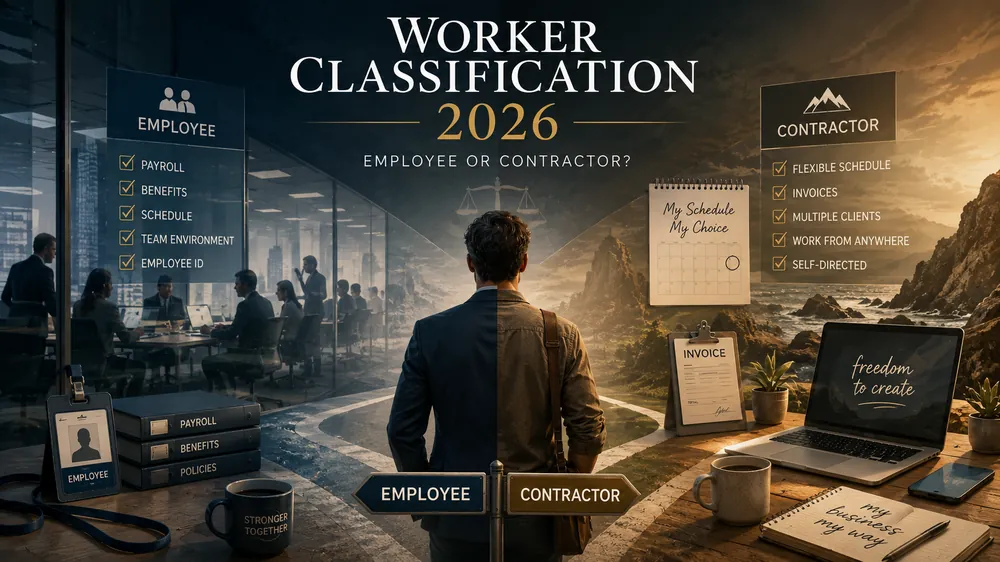
Getting worker classification wrong can mean years of back taxes, unpaid overtime, benefits exposure, unemployment insurance issues, workers’ compensation problems, and penalties. As of August 2026, the federal independent-contractor rule is in flux again — but that does not mean employers can safely treat more workers as contractors. If your team is distributed across states, see our guide to remote work compliance for multi-state employers.
Legal update note: This article is current as of August 2026. Worker-classification laws are changing quickly, especially at the federal level. The DOL’s 2026 independent-contractor rule is proposed, not final, as of this update. Employers should have an attorney review specific classification questions before relying on any general article or checklist.
Worker classification keeps landing businesses in trouble, and 2026 is no exception. As enforcement priorities shift and state tests continue to evolve, the gap between how a business labels a worker and how the law views that relationship can translate into back taxes, penalties, and benefit liability. For companies operating across Arizona, California, and Texas, the rules aren’t identical from state to state, which makes this an easy area to get wrong.
Why Worker Classification Matters So Much
The label determines a cascade of obligations. Employees come with payroll tax withholding, overtime and minimum-wage protections, workers’ compensation, unemployment insurance, and often benefits. Independent contractors generally don’t. When a worker is misclassified as a contractor but should have been an employee, the business can be on the hook for what it should have paid all along — plus penalties and interest.
Not sure whether your contractors would survive a state audit? A short review now costs far less than a misclassification claim later. Book a classification review →
What Changed in 2026: The New Federal Classification Proposal
Short answer: Yes, at the federal level, DOL proposed a new rule in 2026 that would change how independent-contractor status is analyzed under federal wage law. But the proposal is not final as of August 2026, and state laws such as California’s ABC test still apply.
In February 2026, the U.S. Department of Labor announced a proposed rule (RIN 1235-AA46) to rescind and replace the 2024 independent-contractor rule, published at 91 Fed. Reg. 9932 (Feb. 27, 2026).1 The proposal concerns employee-or-independent-contractor status under the Fair Labor Standards Act, the Family and Medical Leave Act, and the Migrant and Seasonal Agricultural Worker Protection Act. The public comment period closed on April 28, 2026.2
The proposal would move away from the 2024 rule’s “totality of the circumstances” six-factor framework and return to an economic-reality analysis that elevates two core factors:
- the nature and degree of control over the work; and
- the worker’s opportunity for profit or loss based on initiative and/or investment.
Specifically, the proposal would rescind the analysis currently set forth in 29 C.F.R. part 795 and replace it with the analysis adopted in DOL’s January 7, 2021 final rule, with modifications.
Three additional factors round out the analysis: the skill required for the work, the permanence of the working relationship, and whether the work is part of an integrated unit of production. These factors are non-exhaustive, and no single factor is dispositive.
This did not come out of nowhere. In May 2025, the DOL issued Field Assistance Bulletin 2025-1, instructing investigators to step back from the 2024 rule in enforcement.3 So even before any final rule, the DOL’s enforcement posture had already shifted.
Two cautions matter here. First, although the 2024 rule remains codified at 29 C.F.R. part 795 unless it is amended or rescinded through final rulemaking, WHD has instructed its investigators not to apply the 2024 rule’s analysis in current FLSA enforcement matters. Courts are not automatically bound by DOL guidance in every private dispute. Second, and more importantly: a proposed federal rule is not a classification permission slip. The safest way to read the 2026 development is not “contractors are safe now.” It is “the federal analysis may be shifting, but employers still need to apply the correct test for the specific worker, claim, and state.”
What Changed — and What Did Not
| What changed | What did not change |
|---|---|
| DOL proposed a new federal rule in 2026. | The proposal is not final as of August 2026. |
| The proposal would emphasize two core factors. | Labels and contracts still do not control by themselves. |
| Federal enforcement posture shifted in 2025. | California’s ABC test still applies where California law governs. |
| Federal law may become more contractor-friendly. | Employers must still apply the most protective applicable law. |
The Three-State Test: Arizona vs. California vs. Texas
Short answer: No, the three states do not use the same test. California applies the strict ABC test, Arizona uses a Declaration of Independent Business Status framework, and Texas applies a common-law direction-or-control test. The same worker can be a contractor under one and an employee under another.
This is the part multi-state employers most often get wrong: the same worker can be a contractor under one test and an employee under another.
| Jurisdiction | Main classification approach | Practical risk point |
|---|---|---|
| Federal (FLSA) | Economic-reality analysis; 2026 proposed rule would emphasize control and opportunity for profit/loss as core factors. | Federal rule is in flux; do not assume the proposal is final. |
| California | ABC test; worker presumed employee unless all three prongs are met, unless an exemption applies. | Prong B — work outside the usual course of business — is often the hardest for companies. |
| Arizona | Declaration of Independent Business Status can create a rebuttable presumption, but is not mandatory. | A signed declaration helps, but the actual relationship still matters. |
| Texas | Common-law direction/control test; TWC uses a 20-factor guide. | Control over how, when, and where work is done is central. |
To keep the three straight: California presumes employee status under the ABC test, codified at Labor Code § 2775 (established in Dynamex and codified by AB 5), unless the hiring entity demonstrates all three prongs: (A) the worker is free from the hiring entity’s control and direction; (B) the worker performs work outside the usual course of the hiring entity’s business; and (C) the worker is customarily engaged in an independently established trade, occupation, or business.4 Statutory exemptions apply, so the ABC test does not govern every classification question. Arizona offers a statutory Declaration of Independent Business Status under A.R.S. § 23-1601 — executing one is not mandatory, and declining to execute one creates no adverse presumption. An executed declaration creates a rebuttable presumption of an independent-contractor relationship only where the employing unit also acts in a manner substantially consistent with the declaration.5 Texas common law and Texas Workforce Commission unemployment-tax classification generally focus on the right to direct or control the work, and the TWC publishes a 20-factor guide.6 Texas appellate authority likewise recognizes the Commission’s right-to-control analysis in the unemployment-tax context. See Critical Health Connection, Inc. v. Texas Workforce Commission, 338 S.W.3d 758 (Tex. App.—Austin 2011).
Hiring across Arizona, California, or Texas? The same worker can be a contractor under one test and an employee under another. Learn more about our Labor & Employment services, or schedule a consultation → before your next hire.
New laws, before they catch you off guard.
Monthly. New Arizona, California, and Texas business-law changes, the deadlines attached to them, and what they mean in practice. No spam — unsubscribe anytime.
By subscribing you agree to receive emails from Accord & Shield Legal. This is general information, not legal advice.
California’s ABC Test Still Matters Most
For California workers, the ABC test remains the central risk point — and it is stricter than the federal economic-reality approach. The contract matters, but the working relationship matters more. Prong B is where companies most often stumble: if the worker performs work that is part of what your business actually does, it is hard to satisfy.
California AB 1514 (2025 Cal. Stats., ch. 305, approved October 3, 2025) made narrow changes to two existing exemptions from the ABC test. It reapplies the exemption for certain licensed manicurists until January 1, 2029, and extends the exemption for a commercial fisher working on an American vessel until January 1, 2031. It did not eliminate the ABC test or make California a general control-test state. For related California developments, see our guide to California pay transparency under SB 642. Treat it as a narrow exemption update, not a loosening of California classification law.
Not sure how this applies to your business? A short conversation with counsel can help identify the areas worth reviewing. We offer an initial consultation for businesses in Arizona, California, and Texas.
Schedule a Consultation →What Misclassification Actually Costs
Misclassification is not just a tax issue. A worker who should have been treated as an employee may claim unpaid wages, overtime, benefits, expense reimbursement, unemployment insurance, workers’ compensation coverage, and penalties. In California, the exposure can grow quickly because wage-and-hour claims often bring derivative penalties and recordkeeping issues.
The full exposure can include unpaid overtime, minimum-wage claims, payroll taxes, unemployment insurance, workers’ compensation, benefits claims, wage-statement and paystub issues, meal- and rest-period risk in California, penalties and interest, contract and IP-ownership disputes, agency audits, and class or representative-action risk. We break down the numbers in what 1099 misclassification really costs in 2026.
Common Classification Mistakes
Treating long-term, full-time help as contractors simply to avoid payroll obligations.
Controlling how and when the work is done while still calling the worker a contractor.
Using the same person exclusively for core business functions over a long period.
Relying on a contractor agreement as if the paperwork alone settles the classification.
Assuming the 2026 federal proposal is a green light — it is neither final nor a substitute for state law.
What Employers Should Do Before the Next Hire
If you’re bringing on help, the time to classify correctly is at the start — not after a tax authority or a worker raises the question. A short review of the actual working relationship, against the test that applies in the relevant state, is far cheaper than an audit or a misclassification claim. Review existing contractor relationships against the applicable test, make sure your written agreements reflect how the work actually happens, and keep records showing how each classification decision was made. When in doubt, it’s worth getting a professional read before the relationship is locked in. A related step for many businesses is reviewing how worker and applicant data is handled — see our guide to privacy compliance in CA, TX & AZ — and, if you use automated hiring or screening tools, our AI legal checklist for startups.
Frequently Asked Questions
Did worker classification rules change in 2026?
Yes, at the federal level, the U.S. Department of Labor proposed a new rule in 2026 that would change how independent-contractor status is analyzed under federal wage law. As of August 2026, the proposal is not final. Employers should not assume the federal rule has already changed, and they still need to apply state law where it is stricter or separately applicable.
Is the 2026 DOL independent-contractor rule final?
No. As of August 2026, the DOL’s 2026 independent-contractor rule is proposed, not final. Comments closed on April 28, 2026. Employers should monitor for a final rule and avoid making classification decisions based only on a proposal.
What are the two core factors in the proposed federal rule?
The proposed federal rule would focus on two core factors: the nature and degree of control over the work, and the worker’s opportunity for profit or loss based on initiative and/or investment. Other factors include skill, permanence of the relationship, and whether the work is part of an integrated unit of production.
Does the federal rule change California’s ABC test?
No. California’s ABC test is a state-law test and remains stricter than the federal economic-reality approach. The Department of Labor says the same thing in its own questions and answers on the 2026 proposal: the rule “has no effect on those state wage-and-hour laws that use a more restrictive test, such as the ‘ABC’ test applied in California,” and employers must meet whichever standard gives workers the greatest protection (29 U.S.C. 218). If California law applies, a worker is generally presumed to be an employee unless the hiring entity satisfies all three ABC prongs or a statutory exemption applies.
What is the difference between California, Arizona, and Texas?
California generally uses the ABC test, codified at Labor Code § 2775, subject to statutory exemptions. Arizona allows a Declaration of Independent Business Status to create a rebuttable presumption of independent-contractor status, though the declaration is not mandatory and the presumption arises only where the employing unit also acts in a manner substantially consistent with the declaration. Texas common law and Texas Workforce Commission unemployment-tax classification generally focus on the right to direct or control the work, and the TWC publishes a 20-factor guide.
Can a contractor agreement fix classification problems?
A contractor agreement helps document the relationship, but it does not control classification by itself. Agencies and courts look at the actual working relationship, including control, independence, business risk, and whether the worker is performing work that looks like part of the company’s regular business.
What are the risks of misclassifying a worker?
Misclassification can lead to unpaid wages, overtime, payroll taxes, unemployment insurance, workers’ compensation issues, benefits claims, penalties, interest, and recordkeeping problems. The risk can grow if the same classification mistake applies to multiple workers or continues over several years.
Should startups use contractors or employees?
Startups can use contractors where the relationship is structured correctly and the applicable law supports contractor status. But using a contractor label to avoid payroll, benefits, or wage-and-hour obligations can create significant risk. The right classification depends on the work, the level of control, the state, and how the relationship operates in practice.
Sources
- U.S. Department of Labor, Employee or Independent Contractor Status Under the Fair Labor Standards Act, Family and Medical Leave Act, and Migrant and Seasonal Agricultural Worker Protection Act, RIN 1235-AA46, 91 Fed. Reg. 9932 (Feb. 27, 2026) (Federal Register Document 2026-03962), https://www.federalregister.gov/d/2026-03962
- U.S. Department of Labor, Notice of Proposed Rule: Employee or Independent Contractor Status Under the FLSA, FMLA, and MSPA, RIN 1235-AA46 (2026 rulemaking)
- U.S. Department of Labor, Questions and Answers — NPRM: Employee or Independent Contractor Status Under the FLSA, FMLA, and MSPA
- U.S. Department of Labor, Field Assistance Bulletins (FAB 2025-1)
- California DIR, Independent Contractor FAQ (ABC test)
- Arizona Revised Statutes § 23-1601, Declaration of Independent Business Status
- Texas Workforce Commission, Independent Contractors / Contract Labor
- IRS, Independent Contractor (Self-Employed) or Employee?
This information is current as of August 2026.
This article is current as of August 2026 and is provided for general informational purposes only. It is not legal advice and does not create an attorney-client relationship. Worker-classification laws, agency enforcement positions, and state-law tests can change quickly, and the correct classification depends on the specific facts of the working relationship, the jurisdiction, the statute involved, and how the work is actually performed. Employers should consult qualified legal counsel before classifying or reclassifying workers, using contractor agreements, changing payroll practices, or responding to an audit, complaint, or claim.