Startup Founder Vesting, Explained
 By Nadine Deeb, Esq. · Published · Updated · 11 min read
When founders start a company together, equity often feels simple: split the company, start building, and figure out the details later. That approach can create serious problems.
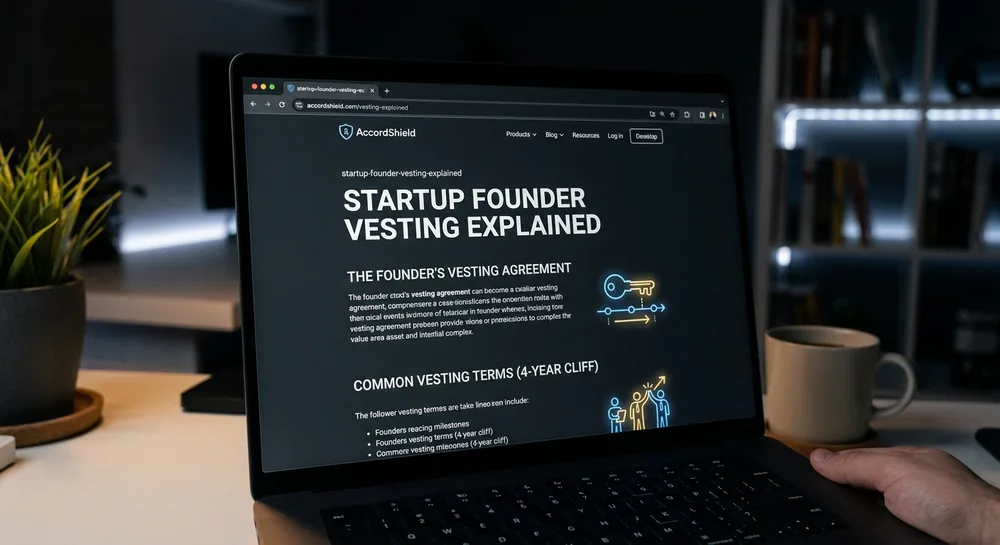
What happens if one founder leaves after three months? What if a co-founder keeps 50% of the company but stops contributing? What if one founder builds the product while another disappears? What if investors ask why a former founder still owns a major stake — and there is no buyback right, no vesting schedule, and no written agreement?
At Accord & Shield Legal, we have seen founder relationships begin with trust and optimism, only to turn into ownership disputes when expectations change. Founder vesting is one of the most important tools for preventing that problem. It is not about mistrust — it is about fairness, accountability, and protecting the company if someone leaves before earning their full ownership stake.
Quick Answer: What Is Founder Vesting?
Founder vesting means a founder earns equity over time or upon meeting certain milestones instead of receiving unconditional ownership immediately. If a founder leaves before the equity fully vests, the company may have the right to repurchase or cancel the unvested portion. Founder vesting helps protect the startup, the remaining founders, and future investors if a co-founder leaves early or stops contributing.
Why Founder Vesting Matters
Without founder vesting, a co-founder may keep a large ownership stake even if they leave early. That can create problems with fundraising, investor diligence, control rights, voting deadlock, buyout negotiations, cap table cleanup, employee equity pools, future acquisitions, co-founder disputes, tax and accounting issues, and company morale.
Investors want to see that founders are incentivized to stay and continue building. If a former founder owns a large percentage of the company without contributing, that can make the company less attractive to investors, employees, and buyers — it is the same dead-equity problem we walk through in what happens when a co-founder leaves.
How Founder Vesting Usually Works
A typical founder vesting structure addresses the total equity granted, the vesting start date and schedule, the cliff period, monthly, quarterly, or annual vesting increments, repurchase rights, the treatment of vested and unvested equity, good leaver and bad leaver rules, acceleration on a sale or termination, tax election requirements, and the board, member, or manager approvals behind it all. The exact structure depends on the entity type, tax strategy, funding plans, state law, and the founder agreement.
What Is a Vesting Cliff?
A vesting cliff is a period during which no equity vests until the founder reaches a specific date. For example, a four-year vesting schedule with a one-year cliff may mean that 25% vests after the first year, with the rest vesting monthly or quarterly after that.
The cliff protects the company if a founder leaves very early. Without one, a founder could leave after a short time and still keep part of the company.
What Are Repurchase Rights?
Founder vesting often works through repurchase rights. In some structures, the founder receives shares or units upfront, but the company has the right to repurchase unvested equity if the founder leaves before vesting is complete. The repurchase price may be the original purchase price, fair market value, or another amount depending on the documents and applicable law.
The key is that the repurchase right must be clearly documented. If the company has no repurchase right, it may not be able to recover unearned equity without negotiation or litigation.
Starting a company with co-founders? Vesting, repurchase rights, and a founder agreement are cheapest to put in place at formation — before anyone’s equity is worth arguing about. We structure founder equity for startups in Arizona, California, and Texas.
Structure your founder equity →Watch the 83(b) Election Issue
Founder vesting can create tax issues. When founders receive restricted stock or other substantially nonvested property in connection with services, they may need to consider whether to make an Internal Revenue Code Section 83(b) election. The IRS explains that an 83(b) election allows the service provider to include the excess of fair market value over the amount paid in income at the time of transfer, rather than waiting until the property vests — see IRS Form 15620 and IRS Publication 525. The election generally must be filed within 30 days of the transfer.
This is a tax-sensitive issue with strict deadlines and consequences. Founders should speak with qualified tax advisors before receiving restricted equity or signing vesting documents.
Founder Vesting Should Match the Entity Structure
Founder vesting looks different depending on whether the startup is a corporation, LLC, partnership, or another entity. The SBA explains that business structure affects day-to-day operations, taxes, liability, paperwork, and fundraising — see the SBA’s Choose a Business Structure guidance.
In a corporation, vesting may involve restricted stock, stock options, repurchase rights, or equity incentive plans. In an LLC, vesting may involve membership interests, profits interests, capital interests, operating agreement provisions, or repurchase terms. The documents should be tailored to the entity — a generic template can create tax, ownership, or enforcement problems. If you have not settled the entity itself yet, start with formation.
Use a Founder Agreement or Operating Agreement
Founder vesting should be documented in the company’s governing documents and related equity agreements — depending on the structure, a founder agreement, restricted stock purchase agreement, stockholders’ agreement, operating agreement, membership interest agreement, equity incentive plan, repurchase agreement, buy-sell agreement, board or member approvals, and cap table records.
An operating agreement can govern LLC internal operations, including ownership percentages, voting rights, duties, profit and loss distribution, and buyout or buy-sell rules. If vesting is not clearly documented, disputes are more likely — especially in 50/50 structures.
New laws, before they catch you off guard.
Monthly. New Arizona, California, and Texas business-law changes, the deadlines attached to them, and what they mean in practice. No spam — unsubscribe anytime.
By subscribing you agree to receive emails from Accord & Shield Legal. This is general information, not legal advice.
Founder Vesting and IP Assignments Work Together
Founder vesting does not solve IP ownership by itself. A founder may leave with unvested equity, but the company still needs to confirm ownership of the source code, product designs, logos, brand assets, website content, inventions, trade secrets, customer lists, pitch decks, business plans, domain names, and social media accounts.
The USPTO explains that patent and trademark ownership can be transferred by assignment and that assignments may be recorded — see USPTO guidance on patent assignments. Vesting should be paired with founder IP assignments so the company owns what the founders create for the business.
Why Investors Care About Founder Vesting
Investors care about founder vesting because it affects alignment and cap table risk. An investor may ask: Are the founders still contributing? How much equity is vested? Does the company have repurchase rights? Did any founder leave with significant equity? Are the vesting documents signed? Was an 83(b) election considered where appropriate? Are founder IP assignments signed? Is the cap table accurate? Are there unresolved founder disputes?
SEC educational materials explain that stock represents equity ownership and that startups may use restricted stock and similar structures in their equity plans — see the SEC’s Capital-Raising Building Blocks. If founder equity is messy, diligence may slow down or investors may demand cleanup before closing.
Already issued founder equity without vesting — or preparing to raise? There are ways to add vesting and clean up the cap table before investors ask, but the tax and consent details matter. Review your options before diligence starts.
Review your equity before you raise →Common Founder Vesting Mistakes
Startups often make avoidable mistakes: issuing founder equity with no vesting; using a vesting schedule but no repurchase right; forgetting the 83(b) election analysis; failing to document board or member approvals; not updating the cap table; treating LLC equity like corporate stock without tax review; failing to address founder departure, disability, death, or termination for cause; failing to define good leaver and bad leaver treatment; ignoring IP assignments; copying investor forms without legal review; and waiting until fundraising to fix ownership documents.
Founder vesting should be part of a broader startup legal structure, not an afterthought.
Good Leaver and Bad Leaver Provisions
Some founder vesting arrangements distinguish between a founder who leaves under acceptable circumstances and one who leaves under problematic circumstances — voluntary resignation, termination without cause, termination for cause, disability, death, breach of confidentiality, misconduct, competition, failure to perform agreed duties, or refusal to sign required documents.
These provisions should be drafted carefully. They can affect valuation, repurchase rights, vested and unvested equity, and future disputes.
Acceleration: What Happens on a Sale?
Founder vesting may include acceleration provisions — some or all unvested equity vests earlier than scheduled, often in connection with a sale, change of control, termination without cause, or both. Common concepts include single-trigger acceleration, double-trigger acceleration, partial acceleration, full acceleration, and no acceleration.
Acceleration can affect investor negotiations and acquisition economics. It should be considered carefully rather than copied from a template.
The Legal Framework Behind Founder Vesting
Corporate or LLC law. The entity structure affects how equity is issued, documented, repurchased, and transferred.
Contract law. Founder vesting usually depends on contracts — founder agreements, stock purchase agreements, operating agreements, and repurchase provisions.
Securities law. Founder equity may be a security. Issuance and transfer should be reviewed for compliance with applicable securities rules and exemptions.
Tax law. Restricted equity, vesting, repurchase rights, and 83(b) elections can create tax consequences.
Intellectual property law. Vesting does not transfer IP by itself. Founders should sign IP assignment agreements.
Employment and service relationships. If a founder is also an employee, officer, contractor, or advisor, separate documents may affect compensation, duties, termination, and equity treatment.
How Accord & Shield Legal Can Help
We help startups, founders, and small businesses structure founder equity before disputes arise — founder agreements, vesting structures, restricted stock purchase agreements, LLC operating agreement vesting provisions, repurchase rights, buy-sell provisions, good leaver and bad leaver terms, founder IP assignments, cap table cleanup, co-founder exit planning, investor diligence preparation, and coordination with tax advisors on 83(b) and equity issues.
We have seen founders wait until after a co-founder leaves or fundraising begins to address vesting. By then, the company may be negotiating with a former founder who still owns a meaningful stake. Getting vesting, repurchase rights, and IP assignments in place early can protect the company’s future.
Red Flags That You Need Legal Help
Speak with counsel if founders split equity with no vesting; a founder has already left; there is no repurchase right; a founder wants to keep equity but stop working; you are raising money or investors are asking about vesting; the cap table is unclear; there is no founder, operating, or shareholder agreement; IP assignments were not signed; you are unsure whether an 83(b) election was needed; your LLC vesting structure was copied from a corporation template; or a founder dispute is developing — including the classic technical co-founder with no written equity agreement.
Final Thoughts
Founder vesting is one of the most important protections a startup can put in place early. It aligns ownership with contribution, protects the company if a founder leaves, gives investors confidence, and reduces the risk of painful founder disputes. But vesting must be documented correctly and coordinated with tax, securities, entity, and IP considerations.
If you are starting a company with co-founders — or if you already have a company but never documented vesting — Accord & Shield Legal can help you put the right structure in place before the issue becomes a dispute.
This article is provided by Accord & Shield Legal for general informational purposes only. It is not legal advice, does not create an attorney-client relationship, and should not be relied upon as a substitute for advice from a qualified attorney who understands your specific facts, entity structure, founder documents, equity terms, tax circumstances, securities issues, intellectual property, jurisdiction, and business goals. Founder vesting may involve corporate, LLC, contract, tax, securities, employment, and intellectual property issues. Section 83(b), restricted equity, tax, and securities matters should be reviewed with qualified tax and securities professionals. Do not send confidential or privileged information unless and until an attorney-client relationship has been formally established in writing. Prior results do not guarantee a similar outcome.
Frequently Asked Questions
What is founder vesting?
Founder vesting means a founder earns full ownership of equity over time or upon milestones, rather than owning it outright from day one. If the founder leaves early, the company can typically repurchase or cancel the unvested portion.
What is a standard founder vesting schedule?
A common structure is four-year vesting with a one-year cliff: nothing vests until the first anniversary, 25% vests at the cliff, and the remainder vests monthly or quarterly after that. The right schedule depends on the company and the founders.
What is a vesting cliff?
A cliff is an initial period during which no equity vests. If the founder leaves before the cliff date, they generally keep nothing; if they stay past it, a block of equity vests at once.
What is the difference between single-trigger and double-trigger acceleration?
Single-trigger acceleration vests equity on one event, often a company sale. Double-trigger acceleration requires two events, typically a sale plus termination without cause. Investors generally prefer double-trigger structures.
What is an 83(b) election?
An 83(b) election tells the IRS to tax restricted stock at grant instead of as it vests. It generally must be filed within 30 days of the transfer, and missing the window can create significant tax consequences as the equity appreciates. Confirm timing and suitability with a tax professional.
Does vesting apply to LLCs?
Vesting concepts can be adapted to LLC membership interests, often through repurchase or forfeiture provisions in the operating agreement, though the tax and drafting details differ from corporate restricted stock.
Can founders add vesting after the company is formed?
Yes. Founders can adopt vesting later through restriction agreements, and investors often require it at a financing. Adding vesting after equity has been issued raises tax and consent issues that should be handled deliberately.
Do I need a lawyer to set up founder vesting?
A lawyer can help structure the schedule, draft repurchase rights and acceleration triggers, coordinate the 83(b) timing with a tax advisor, and align vesting with the founder agreement, IP assignments, and cap table.