Employee Classification Compliance: W-2 vs. 1099 in 2026
 By Nadine Deeb, Esq. · Published · Updated August 9, 2026 · Last legally reviewed August 9, 2026 · 21 min read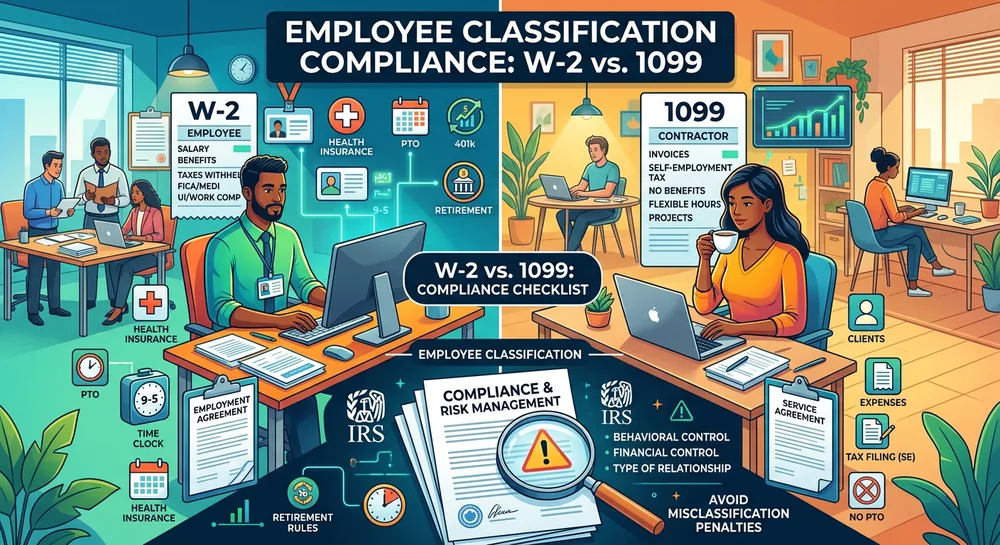
Worker classification is one of the most common employment-law mistakes businesses make — and one of the most expensive.
A company may call someone a “1099 contractor.” The agreement may say “independent contractor.” The worker may prefer contractor status. The company may pay through invoices instead of payroll.
None of that is conclusive.
Federal and state agencies look at the real working relationship, not just the label. If the facts show the worker is legally an employee, the business may owe unpaid wages, overtime, payroll taxes, unemployment contributions, workers’ compensation premiums, benefits, penalties, interest, and attorneys’ fees.
For employers hiring in California, Texas, and Arizona, the analysis can be especially tricky because federal law, IRS rules, and state-specific tests may all apply at the same time.
The practical question is not: “Can we pay this person on a 1099?” The better question is:
“Can we defend independent-contractor status if the DOL, IRS, state labor agency, unemployment agency, or plaintiff’s lawyer reviews the relationship?”
W-2 Employee vs. 1099 Contractor: Why the Label Is Not Enough
Businesses often think classification is a paperwork choice:
- W-2 for employees;
- 1099 for contractors;
- payroll for employees;
- invoices for contractors.
That is too simple.
A worker’s tax form is the result of the classification — not the reason for it. A company cannot create independent-contractor status just by issuing a Form 1099, signing a contractor agreement, or avoiding payroll.
The law asks how the relationship actually works. Relevant facts may include:
- who controls how the work is performed;
- whether the worker can set their own schedule;
- whether the worker can work for other clients;
- whether the worker invests in their own tools, equipment, insurance, or business infrastructure;
- whether the worker can make a profit or suffer a loss;
- whether the work is part of the company’s regular business;
- whether the relationship is project-based or indefinite;
- whether the worker hires helpers;
- whether the worker advertises services to the market;
- whether the company trains, supervises, or disciplines the worker; and
- whether the worker is economically dependent on the company.
No single factor answers every classification question. Different laws use different tests. A worker may be treated one way for one statute and differently for another.
That is why “we have a contractor agreement” is not a classification strategy.
Why Misclassification Is So Costly
Misclassification can create several layers of exposure at once.
A misclassified worker may claim they were denied:
- minimum wage;
- overtime;
- meal and rest breaks where required by state law;
- paid sick leave;
- wage statements;
- expense reimbursement;
- unemployment insurance;
- workers’ compensation coverage;
- employee benefits;
- tax withholding; or
- protection under employment laws that apply to employees but not contractors.
Agencies may also pursue the business for:
- unpaid payroll taxes;
- unpaid unemployment contributions;
- penalties and interest;
- failure to maintain records;
- failure to provide wage statements;
- failure to carry workers’ compensation coverage;
- civil penalties;
- liquidated damages; and
- attorneys’ fees.
The risk is not limited to one worker. Classification problems often affect a category of workers — sales representatives, installers, drivers, nurses, designers, consultants, trainers, technicians, or field workers. One complaint can become an audit. One audit can become a class or collective action.
For startups and SMBs, that can be devastating.
What Federal Independent-Contractor Standard Applies While the DOL Rule Is in Flux?
At the federal wage-and-hour level, the U.S. Department of Labor applies the Fair Labor Standards Act’s economic-reality analysis to determine whether a worker is an employee or an independent contractor for minimum-wage and overtime purposes. As of August 2026, the regulation on the books, the Wage and Hour Division’s enforcement position, and the rule the Department has proposed are not the same. Employers should distinguish all three.
First, the regulation on the books. The DOL published its 2024 employee-or-independent-contractor final rule on January 10, 2024, with an effective date of March 11, 2024. The rule remains codified at 29 C.F.R. part 795 unless and until it is amended or rescinded through final rulemaking. It applies a totality-of-the-circumstances economic-reality test based on six factors: the worker’s opportunity for profit or loss depending on managerial skill; investments by the worker and the potential employer; the degree of permanence of the work relationship; the nature and degree of control; the extent to which the work performed is integral to the potential employer’s business; and the worker’s skill and initiative.
Second, the Wage and Hour Division’s current enforcement position. In May 2025, the DOL issued Field Assistance Bulletin 2025-1, instructing investigators not to apply the 2024 rule’s analysis in current FLSA enforcement matters. The regulation’s formal status and WHD’s enforcement position therefore differ. The bulletin is agency enforcement guidance; it does not amend the regulation and does not bind courts deciding private litigation.
Third, the proposed replacement. In February 2026, the DOL proposed rescinding the 2024 analysis and replacing it with a modified version of the framework adopted in its January 7, 2021 final rule. The proposal would identify two core factors—the nature and degree of control over the work and the worker’s opportunity for profit or loss based on initiative and/or investment—along with three additional factors concerning skill, permanence, and whether the work is part of an integrated unit of production. The comment period closed on April 28, 2026. As of August 2026, the proposal is not final, and no replacement rule has taken effect. See Employee or Independent Contractor Status Under the Fair Labor Standards Act, Family and Medical Leave Act, and Migrant and Seasonal Agricultural Worker Protection Act, 91 Fed. Reg. 9932 (Feb. 27, 2026), RIN 1235-AA46.
What does that mean in practice? A proposed rule is not permission to reclassify workers. Before making or changing a classification decision, confirm the federal rulemaking’s current status and apply any separately applicable state-law test, which may be stricter than the federal standard.
The IRS Tax Overlay
The IRS classification analysis matters because worker status affects payroll taxes, withholding, reporting, and employment-tax obligations.
The IRS explains that if an employer-employee relationship exists, the worker is not an independent contractor. Employee earnings are generally subject to income-tax withholding and FICA taxes and are reported on Form W-2. Independent contractors are generally responsible for their own self-employment taxes and receive Form 1099 reporting where applicable. IRS, Independent Contractor Defined.
The IRS commonly looks at categories of control, including:
- behavioral control — whether the company controls or has the right to control how the worker performs the task;
- financial control — whether the worker has meaningful business investment, opportunity for profit or loss, unreimbursed expenses, and market independence; and
- relationship of the parties — how the parties structure the relationship, including contracts, benefits, permanency, and whether the work is a key aspect of the business.
Businesses and workers may ask the IRS to determine worker status using Form SS-8, but that process can take time and does not eliminate exposure under other laws.
Important: IRS classification and DOL classification are related but not identical. Passing one test does not automatically guarantee compliance under every federal and state law.
California: The ABC Test Makes Contractor Status Harder
California is one of the hardest states in which to classify a worker as an independent contractor.
The California Labor Commissioner explains that California uses the ABC test for many worker-classification questions. Under that test, a worker is presumed to be an employee unless the hiring entity proves all three parts of the test. The California Department of Industrial Relations notes that the California Supreme Court adopted the ABC test in Dynamex and that AB 5 adopted the test for California labor, unemployment, and wage-order purposes, subject to later amendments and exceptions. California DIR, Independent Contractors FAQ.
Under the ABC test, the hiring entity generally must show:
A — Freedom from Control
The worker must be free from the control and direction of the hiring entity in connection with the performance of the work, both under the contract and in fact. This means the written agreement and the real-world relationship both matter.
Red flags include:
- company-set hours;
- required attendance at internal meetings;
- close supervision;
- mandatory training;
- company scripts or detailed procedures;
- discipline for how work is performed;
- restrictions on working for others; and
- manager approval required for routine work decisions.
B — Work Outside the Usual Course of Business
The worker must perform work outside the usual course of the hiring entity’s business. This is often the hardest prong for California employers.
A bakery hiring a plumber to fix a sink may satisfy this prong. A bakery hiring cake decorators as “contractors” likely has a problem. A software company hiring software developers as 1099 contractors likely has a problem. A marketing agency hiring copywriters to perform client marketing work may have a problem.
If the worker is doing the thing the company sells, California contractor status becomes much harder to defend.
C — Independently Established Trade, Occupation, or Business
The worker must be customarily engaged in an independently established trade, occupation, or business of the same nature as the work performed. Useful facts may include:
- the worker has an established business entity;
- the worker advertises services to the public;
- the worker has multiple clients;
- the worker maintains separate insurance;
- the worker has a business website;
- the worker sets their own rates;
- the worker provides their own tools and equipment;
- the worker can hire assistants; and
- the worker bears real entrepreneurial risk.
A side agreement saying “contractor may work for others” is not enough if, in practice, the worker only works for the company and functions like staff.
California Exceptions Are Not a Shortcut
California has numerous statutory exceptions and special rules. Some occupations and business-to-business relationships may be analyzed under a different test, often associated with the older Borello multifactor standard.
But exceptions are technical. They may require specific conditions, documentation, licensing, business independence, written contracts, separate business locations, separate clientele, and other facts.
Employers should not assume an exception applies just because the worker is skilled, remote, part-time, incorporated, or paid by invoice.
California takeaway: if the worker performs core business work, under company control, and does not run a real independent business, 1099 classification is high risk.
Texas: Control Is the Central Question
Texas is generally more flexible than California, but misclassification still creates risk.
For unemployment-tax purposes, the Texas Workforce Commission explains that Texas uses a direction-or-control analysis. The worker is generally treated as an employee unless the Commission is satisfied that the service has been and will continue to be free from control or direction under both the contract and the facts. TWC explains that the key question is whether the purchaser has the right to direct or control the details of the worker’s work. Texas Workforce Commission, Independent Contractors / Contract Labor.
That means Texas employers should focus on both:
- what the contract says; and
- how the work actually happens.
Facts that support contractor status may include:
- the worker controls the manner and means of work;
- the worker sets their own schedule;
- the worker provides their own tools and equipment;
- the worker offers services to the public;
- the worker has multiple clients;
- the worker can realize profit or loss;
- the worker is paid by project or deliverable;
- the worker can hire helpers;
- the worker is not trained like an employee;
- the worker is not supervised like an employee; and
- the relationship is project-based rather than indefinite.
Facts that undermine contractor status include:
- mandatory company hours;
- required daily check-ins;
- company-provided tools and equipment;
- company training;
- exclusivity;
- discipline like an employee;
- long-term indefinite work;
- payment like payroll;
- reimbursement like staff;
- required internal meetings; and
- work that is integrated into the company’s normal operations.
Texas takeaway: a contractor agreement helps, but the real issue is whether the company retains the right to direct and control the work.
New laws, before they catch you off guard.
Monthly. New Arizona, California, and Texas business-law changes, the deadlines attached to them, and what they mean in practice. No spam — unsubscribe anytime.
By subscribing you agree to receive emails from Accord & Shield Legal. This is general information, not legal advice.
Arizona: Do Not Assume “1099” Means Safe
Arizona employers should also be careful.
Arizona law includes worker-classification provisions tied to federal FLSA standards and places the burden on the party for whom the work is performed to show independent-contractor status by clear and convincing evidence in the statutory context. Arizona Revised Statutes § 23-362(D).
That burden matters. If a classification dispute arises, the company should be prepared to show that the worker is truly operating independently, not merely labeled as a contractor.
Arizona employers should evaluate:
- the company’s control over the work;
- whether the worker has a separate business;
- whether the worker serves other clients;
- whether the worker provides tools, equipment, and insurance;
- whether the worker can profit or lose money based on managerial skill;
- whether the relationship is temporary or indefinite;
- whether the work is core to the company’s business; and
- whether the worker is economically dependent on the company.
Arizona takeaway: Arizona may not have California’s ABC test, but employers still need real evidence supporting independent-contractor status.
Not sure whether a worker should be W-2 or 1099?
If you are relying on contractor agreements, invoices, or “everyone in our industry does it this way,” it is time for a classification review. We can review contractor roles, agreements, onboarding workflows, payroll practices, and state-specific risk before an agency or plaintiff’s lawyer does it for you.
Book a worker-classification audit →The Most Common Misclassification Mistakes
Most classification problems do not begin with bad intent. They begin with convenience.
A business wants flexibility. A worker wants higher take-home pay. A founder wants to avoid payroll complexity. A department head wants to try someone out before making a full-time hire. A company wants to move quickly.
Those are understandable business reasons. They are not legal tests. Here are the mistakes we see most often.
Mistake 1: Treating a Contractor Like Staff
A worker is labeled as a contractor but is required to:
- work fixed hours;
- attend staff meetings;
- use company equipment;
- follow detailed company procedures;
- report to a manager;
- request time off;
- work only for the company;
- use a company email address and title;
- appear on the company org chart; and
- perform the same work as employees.
That looks like employment, not independent contracting.
Mistake 2: Using Contractors for Core Business Work
The closer the work is to what the company sells, the greater the risk — especially in California. Examples:
- a software company using 1099 developers for product development;
- a marketing agency using 1099 copywriters for client campaigns;
- a delivery business using 1099 drivers;
- a medical practice using 1099 clinical staff;
- a construction company using 1099 laborers; or
- a consulting firm using 1099 consultants to serve clients.
Some arrangements may be defensible depending on the facts and applicable law. But core-business work deserves close review.
Mistake 3: Assuming Part-Time Means Contractor
Part-time employees are still employees. A worker does not become an independent contractor because they work ten hours per week, work remotely, have another job, or are paid hourly through invoices.
The question is control, independence, economic dependence, and the applicable legal test — not the number of hours alone.
Mistake 4: Letting the Worker Choose the Classification
A worker may ask to be paid as a contractor. They may prefer gross payments without withholding. They may want flexibility. They may even sign an agreement confirming contractor status.
That does not make the classification lawful. Workers generally cannot waive statutory wage, tax, unemployment, workers’ compensation, or employee-protection rules by agreement.
Mistake 5: Copying a Competitor’s Model
“We do it this way because everyone in our industry does it this way” is not a defense. Industry practice may explain why a business adopted a model, but it does not decide whether the model is lawful.
Mistake 6: Using One Contractor Agreement Everywhere
A national contractor template may not work across states. California, Texas, Arizona, federal wage-and-hour law, IRS rules, unemployment agencies, and workers’ compensation systems may all ask related but different questions. A one-size-fits-all agreement can create false comfort.
Mistake 7: Forgetting About Reclassification Risk During Growth
A contractor relationship that seemed defensible at the beginning may become risky over time. For example:
- a short project becomes indefinite;
- a consultant becomes integrated into the team;
- the company gives the worker a company email and title;
- the worker stops serving other clients;
- managers begin setting daily tasks;
- the company provides tools and equipment;
- the worker becomes essential to operations; or
- the worker starts managing employees.
Classification should be revisited as the relationship changes.
Red Flags That a “Contractor” May Really Be an Employee
Employers should pause before using 1099 classification when the worker:
- works full-time or near full-time for the company;
- works indefinitely rather than on a defined project;
- performs the same work as employees;
- performs work central to the company’s business;
- is paid hourly or weekly like staff;
- receives training from the company;
- is supervised by company managers;
- uses company tools, systems, email, or equipment;
- must follow company policies written for employees;
- cannot work for competitors or other clients;
- has no real business entity or separate clientele;
- does not advertise services to the public;
- has no meaningful opportunity for profit or loss;
- cannot hire helpers;
- requests time off like an employee;
- is included on internal org charts; or
- is called a “contractor” only because payroll is inconvenient.
One red flag does not always decide the issue. But multiple red flags should trigger a legal review.
When 1099 Classification Is More Defensible
Independent-contractor classification is usually easier to defend when the worker is genuinely in business for themselves. Supportive facts may include:
- the worker has an established business;
- the worker serves multiple clients;
- the worker markets services to the public;
- the worker controls how the work is performed;
- the worker sets their own schedule;
- the worker provides their own tools, software, equipment, insurance, and workspace;
- the worker charges by project, milestone, or deliverable;
- the worker can make a profit through managerial skill;
- the worker can suffer a loss;
- the worker can hire assistants or subcontractors;
- the worker is engaged for a defined project;
- the relationship has a clear end point;
- the work is not core to the company’s usual business; and
- the contract matches the real-world facts.
Examples may include:
- a web designer hired to redesign a law firm’s website;
- a CPA hired to prepare a company’s tax return;
- a licensed plumber hired to repair an office leak;
- a consultant hired for a defined implementation project;
- a photographer hired for one event; or
- a fractional executive who maintains an independent practice serving multiple companies.
Even then, employers should document the basis for the classification.
Practical Classification Checklist
Before classifying a worker as a 1099 contractor, answer these questions.
1. What Work Will the Person Perform?
Is the work central to the company’s business, or is it a separate service? If the worker is doing the same work the company sells to customers, contractor status is riskier.
2. Who Controls the Work?
Will the company control only the final result, or will it control the details of how the work is performed? The more the company controls methods, schedule, training, tools, and daily priorities, the more the worker looks like an employee.
3. Does the Worker Have an Independent Business?
Does the worker have:
- a business entity;
- other clients;
- advertising;
- insurance;
- business expenses;
- separate tools;
- a website;
- professional licenses;
- the ability to hire help; and
- real entrepreneurial risk?
If not, the worker may be economically dependent on the company.
4. Is the Relationship Project-Based?
A defined project with a clear deliverable is more contractor-like than indefinite, ongoing work. Open-ended “contractor” relationships often become employment relationships in practice.
5. How Will the Worker Be Paid?
Payment by project, milestone, or deliverable usually supports contractor status more than hourly, weekly, or salary-like payment. Payment method is not conclusive, but it matters.
6. Can the Worker Work for Others?
A real independent contractor usually can serve other clients. Exclusivity, noncompetes, full-time availability expectations, or practical restrictions on outside work may undermine contractor status.
7. Does the Contract Match Reality?
A contractor agreement should accurately describe the relationship. It should not say the worker controls the work if managers actually control the work. It should not say the worker provides tools if the company provides everything. It should not say the worker has other clients if the company requires exclusivity.
8. Which Laws Apply?
Consider:
- federal wage-and-hour law;
- IRS tax rules;
- state labor law;
- unemployment insurance rules;
- workers’ compensation rules;
- paid sick leave laws;
- benefits laws;
- industry-specific rules; and
- state-specific contractor statutes.
The right answer may depend on which law is being applied.
Contractor agreements are not enough.
A good contractor agreement helps, but it cannot save a bad classification. We can review the facts, update your contractor agreement, create a classification checklist, and help your team decide when W-2 classification is the safer move.
Get the classification reviewed →How to Fix Classification Problems Before They Become Claims
If your company already uses contractors, do not panic — but do not ignore the issue. A proactive review can reduce risk and help the business make better decisions before an audit, demand letter, unemployment claim, wage complaint, or due diligence request.
Step 1: Inventory All Contractors
Create a list of every worker currently paid outside payroll. Include:
- name;
- role;
- location;
- entity or individual status;
- start date;
- expected end date;
- payment method;
- manager;
- description of services;
- whether they work for other clients;
- whether they use company equipment;
- whether they supervise employees;
- whether they perform core business work; and
- whether a written agreement exists.
Step 2: Sort Contractors by Risk
High-risk categories often include:
- full-time contractors;
- long-term contractors;
- contractors doing core business work;
- contractors managed like employees;
- contractors in California;
- contractors who only work for the company;
- contractors paid hourly;
- contractors using company tools and equipment;
- contractors with company titles or email addresses; and
- contractors who used to be employees.
Start with the highest-risk group.
Step 3: Review the Contracts
A contractor agreement should address:
- scope of work;
- deliverables;
- payment structure;
- independence;
- control over method and means;
- ability to serve other clients;
- tools and equipment;
- insurance;
- taxes;
- confidentiality;
- intellectual property;
- data security;
- compliance obligations;
- indemnity;
- termination; and
- dispute resolution.
But remember: the agreement must match reality.
Step 4: Decide Whether to Reclassify
Some relationships should be converted to W-2 employment. Reclassification may involve:
- payroll setup;
- wage-and-hour review;
- overtime analysis;
- benefits eligibility review;
- workers’ compensation coverage;
- unemployment insurance updates;
- tax review;
- immigration/I-9 onboarding where applicable;
- updated confidentiality and IP agreements;
- manager training; and
- communications with the worker.
Reclassification should be handled carefully. A poorly planned conversion can create admissions, morale problems, or retroactive liability questions.
Step 5: Build a Contractor Approval Process
Do not let managers classify workers on their own. A good process requires legal, HR, or finance review before a contractor is engaged. The approval process should ask:
- What work will be performed?
- Where is the worker located?
- Is the work core to the business?
- Is the worker already operating an independent business?
- Will the worker serve other clients?
- Who controls the work?
- How long will the relationship last?
- How will the worker be paid?
- Does state law impose a stricter test?
- Has the agreement been approved?
Classification should be a gatekeeping decision, not an afterthought.
Special Issues for Startups and SMBs
Startups and small businesses often rely on contractors for speed and flexibility. That is understandable. It also creates risk. Common startup scenarios include:
- classifying early team members as contractors before funding;
- paying developers, marketers, or salespeople on 1099s;
- using “fractional” roles without defining independence;
- converting contractors to employees after a funding round;
- giving contractors equity or options;
- using contractors across several states;
- skipping payroll to preserve cash; and
- treating contractors like employees because the team is small.
Investors, buyers, and lenders may review classification during diligence. Misclassification can become a deal issue because it suggests unpaid wages, taxes, benefits, penalties, and poor employment controls.
If your company is preparing for fundraising, acquisition, or expansion, clean up classification before diligence begins.
Disclaimer
This article is provided by Accord & Shield Legal for general informational purposes only. It is not legal advice, does not create an attorney-client relationship, and should not be relied upon as a substitute for advice from a qualified attorney who understands your specific facts, documents, jurisdiction and business goals. Do not send confidential or privileged information unless and until an attorney-client relationship has been formally established.
Frequently Asked Questions
Can we classify someone as a contractor if they ask for it?
Not necessarily. A worker’s preference does not control legal status. If the facts show an employment relationship, the worker may be an employee even if they requested 1099 treatment and signed a contractor agreement.
Does a signed contractor agreement protect us?
It helps, but it is not enough. Agencies and courts look at the actual working relationship. If the contract says the worker controls the work but managers direct every detail, the facts will matter more than the label.
Can a part-time worker be a W-2 employee?
Yes. Part-time workers can be employees. The number of hours worked does not determine classification by itself.
Can a remote worker be an independent contractor?
Possibly, but remote work does not automatically create contractor status. A remote worker can still be an employee if the company controls the work, the worker is economically dependent on the company, or state law requires employee treatment.
Is payment by invoice enough to make someone a contractor?
No. Invoicing is a payment method. It does not decide legal status.
What if the worker has an LLC?
A worker’s LLC may support independent-business status, but it is not conclusive. The company still needs to review control, independence, economic dependence, the nature of the work, and the applicable legal test.
What if the worker has other clients?
That fact helps, but it does not automatically decide the issue. Other clients are one indicator of independent business status. The full relationship still matters.
Can we use contractors for core business work?
Sometimes, depending on the jurisdiction and facts, but it is higher risk — especially in California. If the worker performs the same services the company sells, contractor status should be reviewed carefully.
What is the safest way to classify a close case?
If the classification is close, W-2 employment is often the safer route. The business may lose some flexibility, but it reduces wage, tax, unemployment, workers’ compensation, and benefits risk.
Should we reclassify existing contractors?
Maybe. Reclassification can reduce future risk, but it should be planned carefully. Employers should review potential retroactive exposure, payroll setup, benefits, communications, and documentation before making changes.
Can misclassification affect a sale or fundraising round?
Yes. Buyers and investors often review worker classification during diligence. A large contractor population performing employee-like work can raise concerns about unpaid wages, taxes, penalties, benefits, and operational controls.
How often should we review contractor classifications?
At least annually, and whenever the relationship changes. Review classification when a contractor becomes long-term, starts working more hours, takes on core business work, moves states, receives company equipment, or becomes more integrated into the team.
Final Takeaway
Worker classification is not a paperwork exercise. It is a facts-and-law analysis.
A strong contractor agreement matters, but it cannot turn an employee into an independent contractor by itself. Employers need to understand the work, the control, the worker’s business independence, the duration of the relationship, and the rules that apply in each jurisdiction.
For California employers, the ABC test makes contractor status difficult in many core-business roles. For Texas employers, control remains central. For Arizona employers, the company should be ready to prove contractor status with real evidence. For all employers, federal wage-and-hour and IRS rules remain part of the analysis.
The safest approach is to classify workers before onboarding, document the basis for the decision, revisit long-term relationships, and reclassify when the facts no longer support 1099 treatment.
Sources
This article draws on the following primary and agency sources:
- U.S. Department of Labor — Final Rule: Employee or Independent Contractor Classification Under the FLSA (published January 10, 2024; effective March 11, 2024)
- Internal Revenue Service — Independent Contractor (Self-Employed) or Employee? / Independent Contractor Defined
- California Department of Industrial Relations — Independent Contractors FAQ (ABC test; Dynamex; AB 5)
- Texas Workforce Commission — Independent Contractors / Contract Labor
- Arizona Revised Statutes § 23-362(D)