Multi-State Business Compliance: What Growing Companies Need to Know Before Expanding
 By Nadine Deeb, Esq. · Published · Updated · 8 min read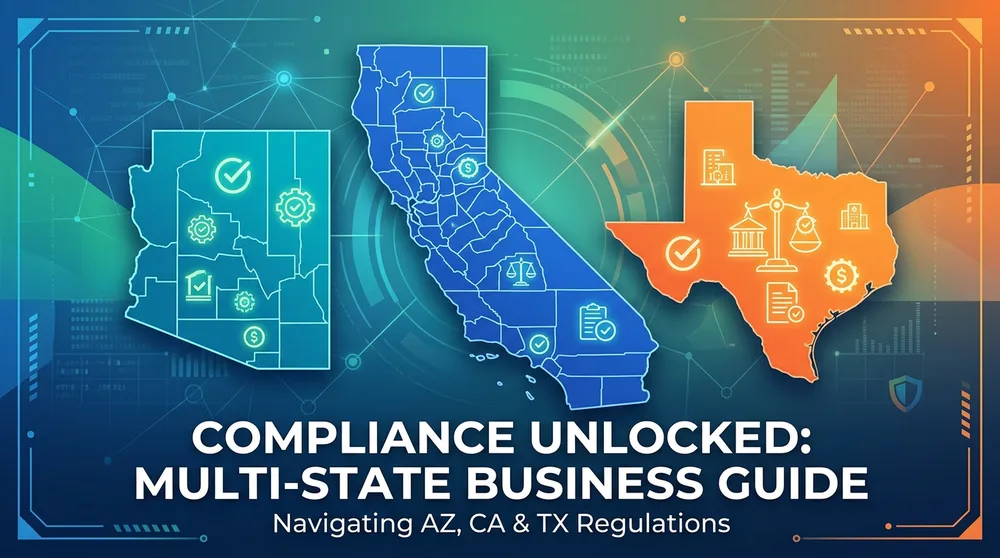
Expanding into a new state is an exciting milestone. It can also create a new layer of legal, tax, employment, licensing, and operational obligations that many companies do not anticipate until after they have already signed contracts, hired employees, opened accounts, or started selling in the new market.
For growing companies, multi-state compliance is not just a filing issue. It is a framework for understanding where the company is doing business, what state registrations may be required, which employment rules apply, how licenses should be handled, and whether contracts and internal policies still fit the company’s operations. Accord & Shield serves clients in Arizona, California, and Texas, and whether your company is expanding from one of these states into another, operating remotely across state lines, or building a regional footprint, early compliance planning can help prevent avoidable penalties, contract friction, and operational disruption.
Why Multi-State Compliance Matters
Many companies assume that forming an LLC or corporation in one state allows them to operate freely everywhere in the United States. In practice, each state may impose its own rules when a company has sufficient business activity there. Common triggers include:
- Maintaining an office, warehouse, storefront, or other physical location;
- Hiring employees or contractors in the state;
- Regularly entering contracts or serving customers in the state;
- Holding inventory, equipment, or other assets in the state;
- Providing regulated services in the state;
- Generating state-specific sales, payroll, or franchise tax obligations; or
- Advertising, licensing, or operating under a trade name in the state.
The key issue is not simply where the company was formed. The question is where the company is transacting business, employing workers, collecting revenue, holding assets, or engaging in regulated activity.
What to Review Before Expanding
A strong multi-state compliance review usually covers six core areas.
1. Foreign Qualification and State Registration
When a company formed in one state begins doing business in another, it may need to register as a foreign entity in the new state. “Foreign” does not mean international here — it generally means the entity was formed under the laws of another state. A Delaware LLC operating in Texas, a Texas company hiring employees in California, or an Arizona entity opening a second location elsewhere may all need to evaluate whether foreign qualification is required.
Failure to register when required can lead to civil penalties and late fees, the inability to maintain a lawsuit in that state until registration is corrected, administrative complications with contracts and state accounts, registered-agent and service-of-process problems, and unnecessary scrutiny from tax, labor, or licensing authorities. Because the rules vary by state, the analysis should happen before operations begin — not after a notice, demand, or penalty arrives.
2. Registered Agent and Service of Process
Most states require registered foreign entities to maintain a registered agent and registered office in the state. Lawsuits, government notices, tax correspondence, and annual report reminders may all be served through that agent — and a missed notice can lead to default judgments, administrative dissolution, suspension, or missed compliance deadlines.
3. State and Local Tax Registration
Multi-state operations can create tax obligations that are separate from entity formation — sales and use tax registration, payroll withholding, franchise or gross receipts taxes, income tax nexus, local business taxes, marketplace facilitator rules, and remote-seller thresholds, depending on the state and the activity. Legal and tax analysis should be coordinated: a business attorney can help identify registration and operational issues, while a qualified CPA or tax advisor should address tax reporting, nexus, apportionment, and filing obligations.
4. Employment Law and a Multi-State Workforce
Hiring one employee in a new state can trigger a broad set of employment obligations: state wage and hour rules, minimum wage and overtime, paid sick or family leave, meal and rest breaks, final paycheck timing, worker classification standards, required notices and posters, restrictive covenant enforceability, remote-work reimbursement rules, harassment-prevention training, and handbook updates.
This matters most for companies with remote workers. A business may have no office in a state and still have employment-law obligations there because an employee works from that state.
Hiring or operating across AZ, CA, and TX? One firm serving all three states can review your registration, employment, and contract exposure before it becomes a penalty or a dispute.
Schedule a Consultation →5. Business Licenses, Permits, and Regulated Activities
Some companies need more than entity registration. Depending on the industry and the state, county, or city, a business may need professional licenses, local business licenses, seller’s permits, contractor registrations, health permits, or other regulatory authorizations. Industries that often require extra review include construction, healthcare and wellness, professional services, financial services, food and hospitality, transportation and logistics, e-commerce, software and data-driven services, franchising, and businesses using independent sales representatives or distributors.
6. Contracts, Terms, and Customer-Facing Documents
Expansion can also affect contracts. A company’s existing templates may not address the legal realities of operating in a new state. Before entering a new market, review governing-law and venue clauses, arbitration provisions, limitation-of-liability language, indemnification, payment terms and collection remedies, consumer-protection disclosures, auto-renewal provisions, warranty disclaimers, data-privacy terms, terms of service and privacy policies, and sales representative or distributor agreements. A contract that works well in one state may need updates before use in another.
New laws, before they catch you off guard.
Monthly. New Arizona, California, and Texas business-law changes, the deadlines attached to them, and what they mean in practice. No spam — unsubscribe anytime.
By subscribing you agree to receive emails from Accord & Shield Legal. This is general information, not legal advice.
Arizona, California, and Texas: Three Different Compliance Postures
Arizona
Arizona is often attractive because of its growth, cost structure, and proximity to western and southwestern markets. Companies expanding into Arizona should evaluate foreign entity registration, transaction privilege tax considerations, employment obligations, local licensing, and industry-specific permits.
California
California is a major market — and one of the most compliance-intensive states for employers. Companies entering California should pay close attention to employment policies, wage and hour rules, worker classification, privacy obligations, tax registration, consumer protection requirements, and contract enforceability.
Texas
Texas continues to attract startups, corporate relocations, and expanding regional businesses. Companies entering Texas should review foreign registration, franchise tax requirements, local permits, registered agent obligations, employment rules, and contract provisions designed for Texas operations.
A Multi-State Compliance Checklist
- Confirm where the entity is formed and where it currently operates.
- Identify every state where the company has employees, contractors, customers, inventory, offices, or recurring business activity.
- Determine whether foreign qualification or other state registration is required.
- Appoint and maintain a registered agent where required.
- Review tax registration requirements with a CPA or tax advisor.
- Update employment policies for each state where workers are located.
- Confirm required state and local licenses or permits.
- Review contracts, terms of service, privacy policies, and customer-facing documents.
- Check trade name, DBA, trademark, and brand-use issues.
- Create a calendar for annual reports, renewals, franchise taxes, licenses, and employment-law updates.
Common Mistakes When Expanding Across State Lines
Even sophisticated companies run into compliance issues when growth moves faster than legal infrastructure. The most common: assuming formation in one state is enough to operate nationally; hiring remote employees without updating state-specific policies; waiting until tax season to evaluate state nexus; using one contract template everywhere without legal review; failing to maintain a registered agent or update entity records; missing annual report or franchise tax deadlines; treating contractors the same in every state; ignoring local license requirements; expanding sales before reviewing consumer-protection and advertising rules; and waiting until a dispute arises to address registration defects. For a broader look at that pattern beyond multi-state issues, see what happens when growth outpaces the legal setup.
These issues are almost always easier and less expensive to address before expansion than after a notice, dispute, audit, or lawsuit.
How Accord & Shield Can Help
Because the firm serves clients in Arizona, California, and Texas, Accord & Shield helps growing companies with multi-state compliance reviews, foreign qualification and registration strategy, contract review and template updates, employment policy coordination, registered agent and corporate governance issues, license and operational compliance planning, terms-of-service and privacy-policy updates, risk review before entering a new market, and ongoing outside general counsel support — with employment compliance coordinated across every state where your team works. Companies in any of the three states can also see our Arizona business attorney, California business attorney, and Texas business attorney pages.
Expanding across state lines? A focused compliance review can identify your registration, employment, contract, and licensing obligations in Arizona, California, and Texas before they become expensive problems.
Schedule a Consultation →Frequently Asked Questions
Do I need to register my business in another state?
Possibly. If your company is transacting business in another state — through employees, a location, inventory, recurring customers, or regulated activity — it may need to register there as a foreign entity. The answer depends on the state and the nature of your activities, and it is best evaluated before operations begin.
Does hiring one remote employee create compliance obligations in another state?
It can. A single employee working from another state may trigger payroll tax registration, workers’ compensation, wage and hour rules, paid leave, required notices, and employment-policy obligations in that state — even if the company has no office there.
Is multi-state compliance only a tax issue?
No. Tax is one part of the analysis, and it belongs with your CPA or tax advisor. Multi-state compliance also involves entity registration, employment law, licensing, contracts, registered agents, privacy terms, and corporate governance — the legal framework around where and how the company operates.
Can Accord & Shield help with Arizona, California, and Texas compliance?
Yes. Accord & Shield serves clients in Arizona, California, and Texas and helps businesses with compliance planning, foreign qualification, contracts, and employment policies across those three jurisdictions.
This article is provided by Accord & Shield Legal for general informational and educational purposes only. It is not legal, tax, accounting, or business advice and should not be relied on as a substitute for advice from a qualified professional who understands your company’s structure, industry, locations, employees, revenue, contracts, tax profile, and specific business activities. Multi-state obligations vary by state and by activity, and state-specific examples in this article are illustrative, not a survey of all state laws. Reading this article, visiting this website, or contacting Accord & Shield does not create an attorney-client relationship; representation is established only through a written engagement agreement. Accord & Shield provides legal services only in jurisdictions where its attorneys are authorized to practice or where otherwise permitted by applicable law. Tax questions should be reviewed with a qualified CPA or tax advisor. Do not send confidential information unless and until an attorney-client relationship has been formally established. Prior results do not guarantee a similar outcome.