Legal Scaling for Growth-Stage Startups: Getting Your Contracts and Governance Ready for Enterprise Deals and Your Next Raise
 By Nadine Deeb, Esq. · Published · 21 min read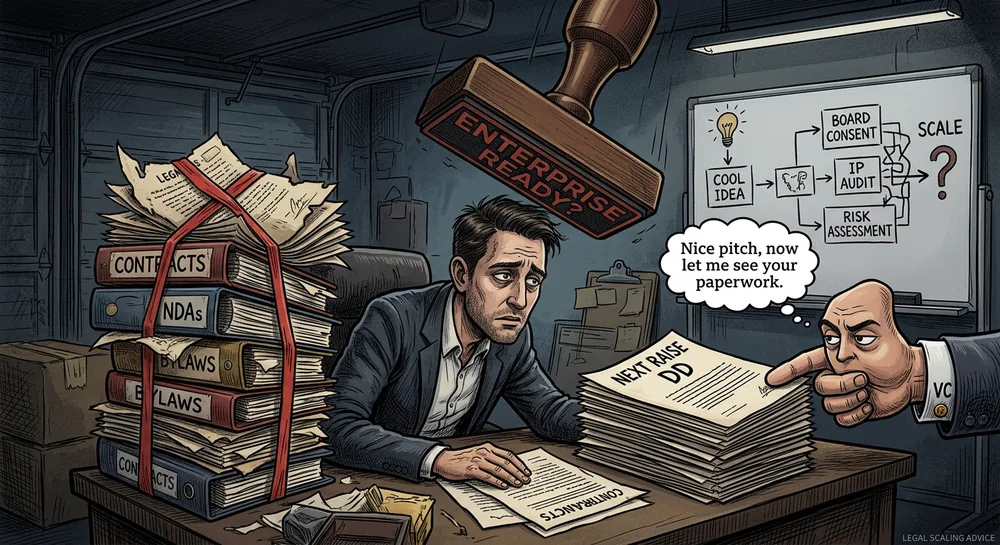
There is a moment in a startup’s life when the paperwork that got it off the ground quietly becomes a liability. The founder agreement scribbled before the first line of code. The contractor who built half the product on a handshake. The first customer contract signed to close the quarter. The cap table living in a spreadsheet. The privacy policy copied when no one was thinking about enterprise security review. The AI tool everyone started using before anyone wrote down a policy. None of it mattered much at ten people and a seed check. At forty people, a Series A term sheet, and a first enterprise customer running a security audit, all of it matters at once.
Quick answer. Legal scaling means upgrading early, informal paperwork into a repeatable operating system that can survive investor diligence and enterprise customer review. The areas that matter most include governance, equity and cap-table records, IP assignments, customer contracts, data, security and AI practices, and employment documents. The goal is readiness, not perfection, and problems are usually cheaper to fix before a counterparty is looking. Accord & Shield Legal standardizes contracts and cleans up governance, equity and IP records for growth-stage companies in Arizona, California and Texas, starting with a free 15-minute consultation.
Growth-stage companies usually do not fail diligence because they were reckless. They fail it because they never went back and cleaned up what they built quickly. That is the legal inflection point most scaling founders feel before they can name it. Early on, the right instinct is to move fast and paper things lightly. But somewhere between seed and Series C, the company crosses into a different operating environment. Investors run real due diligence. Enterprise customers send their own MSAs, DPAs, security questionnaires, and vendor-risk requirements. Every new hire creates equity, employment, confidentiality, and invention-assignment questions. Every new dataset creates privacy, security, retention, and AI-use questions.
The job is no longer simply to move fast. The job is to add legal infrastructure without killing the speed that got the company here. This guide explains what actually breaks when a startup scales — and how to get your contracts, equity, intellectual property, data practices, cybersecurity posture, AI governance, and board process ready for the two events that will test all of them: your next raise and your first serious enterprise deal.
What Is Legal Scaling for a Growth-Stage Startup?
Legal scaling means upgrading the informal legal foundation that worked in the earliest stage of the company into a repeatable operating system that can survive investor diligence, enterprise customer review, rapid hiring, commercial expansion, and eventual exit planning. It does not mean turning the company into a bureaucracy. It means making the legal layer strong enough that growth does not keep reopening the same questions: Who owns the product? Who approved the equity? Are customer contracts assignable? Can the company use the data it collects? Is the privacy policy accurate? Are employees and contractors assigning inventions? Can the company pass a security review? Is the board actually approving what needs approval? Are AI tools being used in a controlled way? Will the cap table hold up when investor counsel reviews it?
A seed-stage startup can survive a lot of informality because the company is still proving the market. A growth-stage startup is different. By the time a company is raising institutional capital, selling to enterprise customers, or preparing for acquisition interest, legal infrastructure becomes part of the product. It affects sales velocity, valuation, closing certainty, investor confidence, and founder leverage.
Why Early-Stage Paperwork Stops Working
Early-stage legal work optimizes for one thing: not slowing the company down. That is often the correct trade-off when the biggest business risk is running out of runway before finding product-market fit. A SAFE closes quickly. A contractor ships code on a short statement of work. A founder equity split gets handled on trust. A first customer contract gets signed to get revenue in the door. A privacy policy gets published because a website needs one. The problem is that shortcuts are invisible until someone with leverage starts looking. At growth stage, someone always looks.
A priced round brings institutional investors and their counsel. They will review equity documents, board approvals, financing history, securities-law compliance, material contracts, employment documents, IP assignments, data practices, and litigation risk. Many venture financings rely on exemptions from Securities Act registration, including Regulation D. Rule 506 remains a core private-offering framework for many startup financings — see 17 C.F.R. § 230.506 and the SEC’s startup fundraising guidance. If you are weighing how to structure that capital, SAFE versus convertible note and structuring investor deals without losing control are useful companions.
A first enterprise customer brings a procurement team, an information-security review, a 50-page MSA, a data processing addendum, insurance requirements, audit rights, indemnity demands, and a security questionnaire that assumes the company already has policies and controls it may never have written. A wave of hiring brings offer letters, option grants, immigration issues, confidentiality obligations, invention assignments, worker classification questions, and compensation consistency concerns. Each is a diligence event. Each turns yesterday’s convenient shortcut into today’s open question. The companies that scale smoothly are the ones that convert early informality into durable infrastructure before those events, not during them.
The Legal Scaling Checklist: What to Fix Before the Next Raise or Enterprise Deal
A growth-stage legal review should focus on the areas most likely to affect financing, sales, valuation, or exit readiness:
- Corporate governance — board approvals, minutes, protective provisions, information rights, consents, and a real governance calendar.
- Equity and cap table — founder stock, option grants, SAFEs, convertible notes, advisor equity, 83(b) elections, and equity-plan administration.
- Intellectual property — founder, employee, contractor, consultant, and vendor invention assignments; trademarks; domains; open-source software; and trade-secret protection.
- Customer contracts — SaaS licensing agreement terms, enterprise MSAs, DPAs, SLAs, assignment restrictions, liability caps, indemnities, audit rights, renewal terms, and change-of-control clauses.
- Data privacy and cybersecurity — privacy notices, data processing terms, subprocessor management, retention, deletion, incident response, access controls, and security questionnaires.
- AI governance — approved AI tools, training-data rights, customer-data restrictions, output ownership, confidentiality, bias, validation, and internal-use policies.
- Employment and contractor infrastructure — offer letters, confidentiality agreements, invention assignments, equity promises, restrictive covenants, classification, and documentation consistency.
- Regulatory and sector-specific issues — securities, privacy, consumer protection, healthcare, fintech, export controls, government contracting, and industry-specific compliance.
- Outside general counsel rhythm — a predictable legal operating cadence so legal cleanup does not happen only during emergencies.
The goal is not perfection. The goal is readiness. When an investor, enterprise customer, lender, insurer, or acquirer asks questions, the company should be able to answer them cleanly.
1. Corporate Governance: From Founder Trust to a Real Board Process
In the earliest days, “the board” is often just the founders talking in Slack, on a call, or across a table. Decisions happen quickly and informally because everyone is close to the work. A priced round changes that. Investors often negotiate board seats, observer rights, protective provisions, and information rights. Overnight, the company has real governance obligations. Certain actions may require board approval, investor consent, or both. Major decisions need a paper trail. Minutes matter. Written consents matter. The cap table has to match the corporate record.
The failure mode is usually not dramatic. It is quiet accumulation: option grants approved by email but never formally granted; board minutes drafted months late or not at all; SAFEs and notes signed but not properly tracked; a cap table spreadsheet that no longer reconciles to issued equity; major contracts signed without required approval; protective provisions triggered without anyone realizing consent was needed. None of these necessarily destroys a company. But each one creates friction when a later investor, acquirer, lender, or auditor asks for the record.
Growth-stage governance means adopting a real board process without burying the company in process. At a minimum, that usually means a current board and stockholder approval file; written consents or minutes for major decisions; clear tracking of investor consent rights; a clean equity ledger and cap table platform; calendar reminders for board meetings and required reporting; and approval workflows for equity grants, debt, major contracts, compensation plans, and transactions outside the ordinary course. Governance is not glamorous. It is one of the first things diligence checks because it tells investors whether the company can be trusted to operate at the next level.
2. Equity and Cap Table: Cleaning Up What You Issued Fast
Equity is where early speed creates the most durable mess. Founder shares may have been issued without vesting. Restricted stock may have been issued without timely tax elections. Option grants may have been promised in offer letters but never formally approved. SAFEs and convertible notes may have stacked up with overlapping caps, discounts, MFN rights, pro rata rights, and side letters. Advisor shares may have been promised informally. Contractors may have been offered equity without a clear agreement. Individually, many of these issues are manageable. Together, they can create a cap table that no investor wants to underwrite.
Before a raise, the cap table should be reconciled and defensible: every share, option, warrant, SAFE, note, and side letter accounted for; vesting schedules documented; equity promises in offer letters matched to actual grants; board approvals in place for grants and issuances; option-plan limits checked; convertibles modeled through the financing; founder vesting and repurchase rights understood; and 83(b) election records confirmed where restricted stock was issued. If founder vesting was never set up, our explainer on founder vesting, cliffs, acceleration, and 83(b) covers why it matters.
The 83(b) issue deserves special care. The IRS’s current Form 15620 instructions state that an 83(b) election must generally be filed no later than 30 days after the property is transferred — see IRS Form 15620, Section 83(b) Election and IRS Publication 5992. Tax treatment is fact-specific, so founders should coordinate with tax advisors before making equity decisions. The goal is simple: when investor counsel opens the cap table, it should answer questions rather than create new ones.
3. Intellectual Property: Proving the Company Actually Owns the Product
IP ownership is one of the first things sophisticated investors, enterprise customers, and acquirers scrutinize because it is often the asset they are really underwriting. The recurring growth-stage problem is the contractor gap: the company believes it owns the code because it paid for it, but the developer, agency, consultant, or offshore team never signed a valid invention-assignment agreement. Payment is not always assignment. A company preparing for a priced round or enterprise diligence should confirm that every person and vendor who contributed to the product — founders, employees, contractors, consultants, agencies, offshore development teams, and advisors who contributed code, product design, architecture, branding, or technical work — assigned the relevant rights to the company.
IP cleanup should also confirm that trademarks are registered or filed in the company’s legal name; domains are owned or controlled by the company, not a founder’s personal account; GitHub, cloud, app-store, design, analytics, and developer accounts are company-controlled; trade secrets are protected by confidentiality agreements and access controls; customer contracts do not accidentally transfer ownership of core product improvements; and open-source software is inventoried and its license obligations understood. Open-source review is not about pretending the company does not use open source — nearly every software company does. The question is whether the company knows what it uses, understands the license obligations, and can explain its process, a risk we cover in open-source licenses in your SaaS product. If early contributor arrangements were never papered, the technical co-founder with no equity agreement is a cautionary companion. A buyer or investor does not want to hear, “We think we own it.” They want to see the documents.
Raising your next round or landing your first enterprise deal? The cleanest time to fix your legal foundation is before a counterparty starts diligence — not during it. We help growth-stage companies get ready.
Book a Free 15-Minute Consultation →4. Customer Contracts: Moving From Founder-Led Sales to Enterprise Deal Discipline
Early customer contracts often reflect survival. The company signs what it needs to sign to land revenue, prove demand, and keep momentum. That works until customer contracts become diligence documents. At growth stage, the company needs a repeatable contracting position. Enterprise customers will negotiate liability caps, indemnities, SLAs, uptime commitments, audit rights, security requirements, assignment clauses, data ownership, AI restrictions, termination rights, and compliance obligations. If each deal is negotiated from scratch, the company will slowly build a contract portfolio full of inconsistent obligations. A first 50-page MSA can be genuinely disorienting — which is why we wrote what to do when your first enterprise customer sends a 50-page MSA.
That inconsistency creates three problems. First, it slows sales because every negotiation becomes bespoke. Second, it creates operational risk because the company may promise things its product, security team, or support function cannot consistently deliver. Third, it creates diligence risk because investors and acquirers will identify nonstandard terms and ask whether they affect revenue quality. A growth-stage contract cleanup should review standard SaaS terms and order forms, enterprise MSAs, data processing addenda, service-level agreements, support terms, security exhibits, assignment and change-of-control restrictions, auto-renewal and termination rights, customer audit rights, most-favored-customer clauses, exclusivity or channel restrictions, liability caps and carveouts, and IP, privacy, security, and regulatory indemnities. The company should know its playbook: what it accepts, what it resists, what requires business approval, and what is too risky for the revenue. Building contracts that survive that scrutiny is the point of diligence-grade contracts.
New laws, before they catch you off guard.
Monthly. New Arizona, California, and Texas business-law changes, the deadlines attached to them, and what they mean in practice. No spam — unsubscribe anytime.
By subscribing you agree to receive emails from Accord & Shield Legal. This is general information, not legal advice.
5. Data Privacy: When Data Practices Become a Sales Gating Item
Data privacy often starts as a website problem: publish a privacy policy and move on. At growth stage, privacy becomes a sales, diligence, and trust issue. Enterprise customers want to know what data the company collects, where it is hosted, who can access it, which subprocessors are involved, how long it is retained, how it is deleted, whether it is used for AI training, and what happens if there is a security incident. Investors want to know whether the company’s actual data practices match its privacy notices and contracts. The FTC has long treated data security and privacy representations as business-critical consumer-protection issues, and its business guidance references the NIST Cybersecurity Framework as a useful tool — see FTC Cybersecurity for Small Business.
A growth-stage privacy review should include website and product privacy notices; cookie and tracking disclosures; customer data processing agreements; vendor and subprocessor lists; data maps and processing records; retention and deletion practices; data subject request procedures; international transfer mechanisms, if applicable; employee and applicant privacy notices; marketing, analytics, pixels, and ad-tech practices; sensitive data, children’s data, financial data, health data, biometric data, or precise geolocation data; and AI training and product-improvement uses. The key question is not just “Do we have a privacy policy?” It is whether the company can prove that its contracts, notices, product behavior, vendor practices, and internal operations are aligned. For consumer-facing SaaS, California privacy policy requirements for 2026 is a useful reference.
6. Cybersecurity: Enterprise Buyers Now Audit the Legal Layer
Cybersecurity has moved from IT checklist to legal and commercial gating item. Enterprise customers expect startups to answer security questionnaires, provide SOC 2 or similar reports, document incident response, describe access controls, and accept contractual security obligations. NIST Cybersecurity Framework 2.0 is the most useful external benchmark to cite in this context; its core functions — govern, identify, protect, detect, respond, and recover — provide a structure that enterprise buyers recognize.
Growth-stage companies should be ready to explain who owns security internally; whether there is a written information-security program; how access is granted, reviewed, and terminated; whether MFA is required; how vulnerabilities are identified and remediated; whether penetration tests or audits have been performed; how incidents are escalated and documented; whether backups and disaster recovery are tested; what customer security obligations the company has accepted; and which vendors and subprocessors touch customer data. For companies that may become public or be acquired by public companies, cybersecurity governance can also intersect with securities disclosure: the SEC’s rules added 17 C.F.R. § 229.106, addressing cybersecurity risk management, strategy, and governance disclosures — see the SEC Adopts Rules on Cybersecurity Risk Management, Strategy, Governance, and Incident Disclosure by Public Companies. Even private startups should pay attention, because public-company customers, acquirers, insurers, and late-stage investors increasingly ask diligence questions through the same governance lens.
7. AI Governance: The New Diligence Question
AI is now part of startup operations even when the company does not market itself as an AI company. Teams use AI for coding, customer support, sales enablement, analytics, product features, document review, marketing, and internal workflows. That creates a new diligence question: does the company know where AI is being used, what data is going into it, who owns the outputs, and what risks the business has accepted? NIST AI Risk Management Framework 1.0 is a strong authority to cite because it provides a voluntary framework to help organizations design, develop, deploy, and use AI systems responsibly.
A growth-stage AI review should ask which AI tools are approved for company use; whether employees are putting customer data, source code, or confidential information into public AI tools; whether customer contracts restrict AI training or automated processing; whether the company uses AI in customer-facing product features; who owns or licenses the models; what training data was used; whether outputs are reviewed before customer or public use; whether there are bias, accuracy, explainability, or validation concerns; whether vendor contracts allow the intended AI use; and whether there is a written AI policy. For many startups, the right first step is not a 60-page AI policy. It is a practical rule set: approved tools, prohibited data inputs, human review expectations, customer-data restrictions, vendor review, and escalation for high-risk uses. Employers layering AI into the workplace should also review employee NDAs and AI tools in 2026.
Outgrowing one-off legal firefighting? Scaling companies need a repeatable legal operating system — standardized contracts, current governance, and counsel who already knows the business. That is what we build.
Book a Free 15-Minute Consultation →8. Employment, Contractors, and Hiring Infrastructure
Growth turns informal people practices into legal risk. At five employees, inconsistent documents are annoying. At fifty employees, they become diligence issues. A growth-stage employment cleanup should review offer letters, employment agreements, confidentiality agreements, invention assignments, contractor agreements, worker classification, equity promises, commission plans, bonus arrangements, restrictive covenants, immigration and work authorization, handbook policies, and termination procedures.
The two issues that surface most often are inconsistency and missing IP language. If employees and contractors are signing different forms across time, the company may have different rights and obligations depending on when someone joined. If invention-assignment language is missing, the product ownership story becomes harder to prove. Hiring quickly is not the problem. Hiring quickly without standard documents is.
The Story We See: The Startup That Waits Until the Deal Is Live
A familiar pattern looks like this. A founder gets a serious enterprise opportunity. The logo would change the company. Sales is excited. The investor update practically writes itself. Then procurement sends the contract package. The customer wants a detailed security exhibit, a data processing addendum, broad IP indemnity, unlimited liability for confidentiality and data breach, audit rights, a right to terminate for convenience, strict assignment restrictions, and confirmation that customer data will not be used to train AI models.
The founder realizes the company has never answered those questions in one place. The privacy policy is outdated. The security policy is half-written. The contractor who built the original platform never signed the current invention-assignment form. The company has no approved AI-use policy. The standard terms do not match what sales has been promising. The board approved the last option grants informally, but the paperwork is not complete. None of this means the company is broken. It means the company has outgrown its legal operating system. This is where Accord & Shield helps growth-stage startups: not by slowing the business down, but by turning legal cleanup into a practical scaling project — making the company easier to fund, easier to sell to enterprise customers, easier to diligence, and easier to operate.
How Accord & Shield Helps Growth-Stage Startups Scale Legally
Accord & Shield works with startups and technology companies that are past the “just get it done” stage and need legal infrastructure that can support real growth. We help founders and leadership teams build the legal layer that investors, enterprise customers, strategic partners, and acquirers expect to see: contract standardization (SaaS terms, MSAs, DPAs, order forms, SLAs, vendor and partner agreements, and customer playbooks); enterprise deal support (negotiation strategy for liability caps, indemnities, audit rights, security terms, assignment clauses, data use, AI restrictions, and procurement redlines); fundraising readiness (cap table review, SAFE/note cleanup, board approvals, financing diligence, investor-rights review, and coordination with tax and securities counsel as needed); IP cleanup; governance systems; privacy, cyber, and AI readiness; and outside general counsel support that understands the company rather than one-off firefighting.
The best legal work at growth stage is not theoretical. It is operational. It helps sales close deals, helps finance raise money, helps product ship responsibly, helps leadership make decisions, and helps the company avoid avoidable diligence surprises. Our Corporate Formation and Contract Review & Negotiation practices support this work as an ongoing relationship.
When Should a Startup Start Legal Scaling?
The best time to clean up legal infrastructure is before the company is under pressure. Start before a Series A, Series B, or growth-equity raise; a first major enterprise customer; a wave of hiring; a material channel, reseller, or strategic partnership; a new product launch involving sensitive data or AI; expansion into regulated industries; acquisition discussions; a customer security audit; or a board expansion or investor governance reset. Legal issues are almost always cheaper to fix before a counterparty is looking. Once a round, enterprise contract, or acquisition process is live, the company has less time and less leverage. For the earlier signals—the ones that appear before a milestone forces the issue—see signs a company has outgrown its legal setup.
A Practical 30-Day Legal Scaling Sprint
For many growth-stage companies, the right starting point is a focused legal sprint. In 30 days, a company can often identify the biggest issues and prioritize fixes.
Week 1 — Map the Legal Stack. Collect corporate records, cap table documents, financing documents, customer contracts, vendor agreements, employment forms, contractor agreements, IP assignments, privacy policies, security materials, and AI-related practices.
Week 2 — Identify Diligence Gaps. Review what would matter most to investors and enterprise customers: cap table integrity, board approvals, IP ownership, contract consistency, privacy and data practices, security posture, and AI usage.
Week 3 — Fix High-Leverage Documents. Update or prepare the documents that unblock growth: standard customer terms, DPA, security exhibit, contractor agreement, invention assignment, board consent templates, option-grant process, privacy notice, and AI-use policy.
Week 4 — Build the Operating Rhythm. Create a practical cadence: monthly or quarterly legal check-ins, contract escalation rules, board approval workflows, equity grant procedures, vendor review, subprocessor tracking, and a living diligence folder. The point is not to solve every legal issue in a month. The point is to replace legal chaos with a system.
Frequently Asked Questions
What does it mean to scale legal infrastructure at a startup?
Scaling legal infrastructure means upgrading the informal contracts, equity records, IP paperwork, data practices, cybersecurity policies, AI rules, and governance processes a company used in its early days into documents and workflows that can survive enterprise-customer diligence, investor review, rapid hiring, and eventual exit planning.
When should a startup clean up its legal foundation?
The best windows are before raising a new round, before signing a first major enterprise customer, before a wave of hiring, before launching a product that uses sensitive data or AI, and before any conversation about an acquisition. Problems are usually cheaper and easier to fix before a counterparty is looking.
What legal problems most often surface during Series A or Series B diligence?
Common issues include IP assignment gaps from early contractors, missing or inconsistent equity documentation, unapproved option grants, incomplete board consents, customer contracts with assignment or change-of-control restrictions, weak data processing terms, unclear privacy practices, and open-source or AI use without a documented policy.
Do we need a formal board and governance process after a priced round?
Usually, yes. A priced round often adds investor directors, protective provisions, information rights, and formal approval requirements. That means board approvals, accurate minutes, and a working cap table become operating obligations rather than nice-to-haves.
How do enterprise customer contracts change as a startup scales?
Enterprise customers often send their own MSAs, DPAs, security requirements, audit rights, indemnities, SLAs, insurance requirements, and assignment clauses. A scaling startup needs a repeatable contract position — what it accepts, what it negotiates, and what it escalates — instead of reinventing the answer for every deal.
What IP cleanup matters most for a growing startup?
The most important step is confirming that every founder, employee, contractor, consultant, agency, and vendor that contributed to the product signed appropriate confidentiality and invention-assignment documents. The company should also confirm trademark, domain, repository, open-source, and third-party component ownership or license rights.
How does data privacy scale with the business?
As a startup adds customers, employees, vendors, integrations, and data sources, it takes on more privacy obligations. That may include accurate privacy notices, data processing agreements, subprocessor disclosures, retention and deletion practices, security controls, data subject request procedures, and a clear position on whether customer data can be used for AI training or product improvement.
Why does AI governance matter for startups that are not AI companies?
Even non-AI startups often use AI in coding, marketing, support, analytics, product features, sales, or internal operations. Investors and enterprise customers may ask whether employees are putting confidential information, source code, customer data, or personal information into AI tools and whether the company has a written policy controlling that use.
Should a startup handle legal scaling in-house or with outside counsel?
Most growth-stage startups do not need a full-time general counsel immediately. They do need consistent outside counsel who understands the business, standardizes contracts, keeps governance current, supports enterprise negotiations, and prepares the company for financing and diligence. The goal is a repeatable legal operating system, not one-off firefighting.
This article is for general informational purposes only and does not constitute legal, tax, accounting, investment, cybersecurity, or regulatory advice. Reading this article does not create an attorney-client relationship with Accord & Shield Legal or any of its attorneys. You should not act or refrain from acting based on this article without seeking advice from qualified counsel licensed in the appropriate jurisdiction. Startup legal needs are highly fact-specific and may vary based on corporate structure, state of formation, financing history, investor rights, securities-law exemptions, tax elections, equity plans, employment practices, intellectual-property ownership, customer contracts, data practices, cybersecurity posture, AI use, industry, geography, and other circumstances. Laws, regulations, agency guidance, filing thresholds, enforcement priorities, and market practices change frequently, and the citations and external resources referenced in this article should be checked for currentness before being relied upon. Tax matters, including founder equity, restricted stock, option grants, 83(b) elections, and compensation issues, should be reviewed with a qualified CPA or tax advisor. Cybersecurity, privacy, AI, and technical matters may require coordination with security professionals, privacy specialists, or technical advisors. No outcome is guaranteed; prior results, examples, or descriptions of services do not guarantee a similar result in any current or future matter. This article may be considered attorney advertising in some jurisdictions.