Can AI Draft Your Business’s Legal Documents? What Owners Should Know
 By Nadine Deeb, Esq. · Published · 11 min read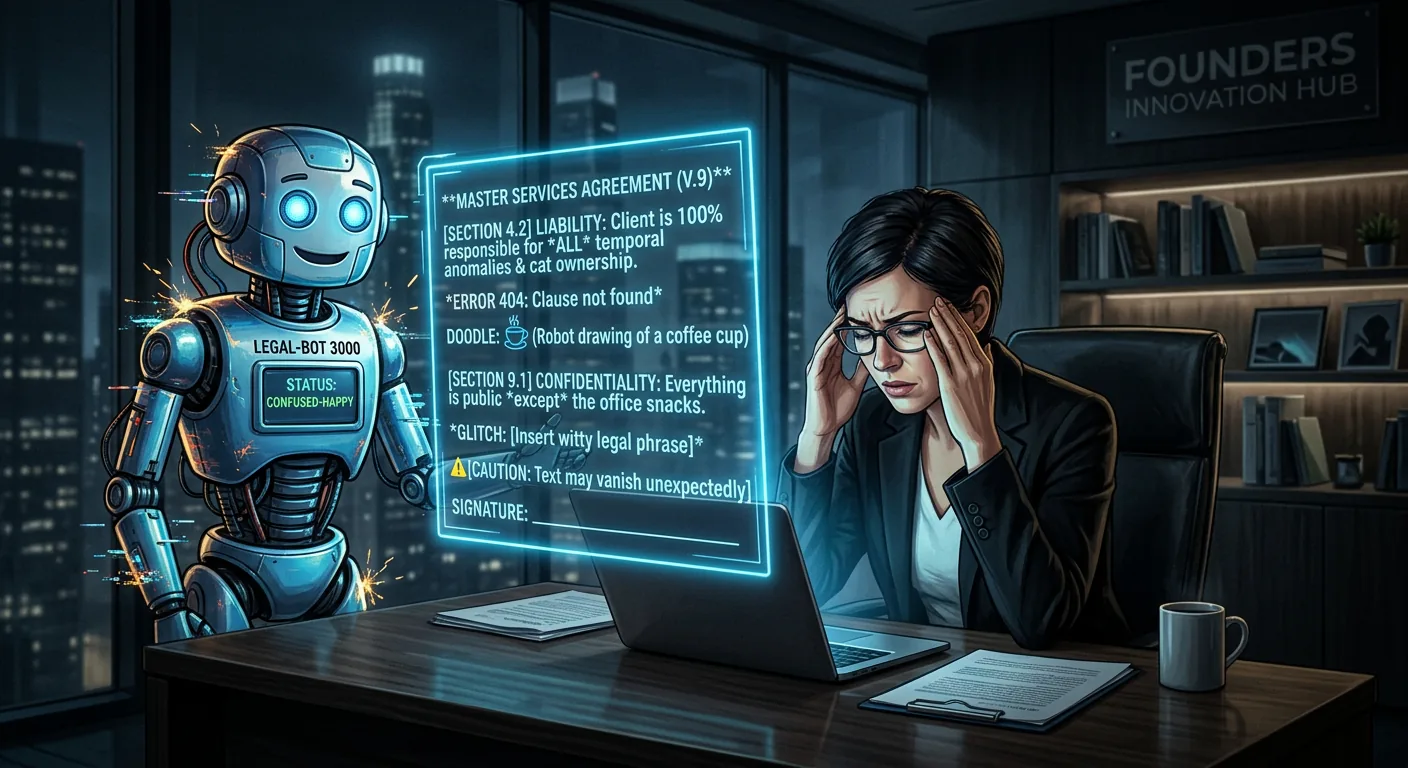
A business owner opens an AI tool late at night and types a simple prompt: “Draft me an operating agreement for my new LLC.” Thirty seconds later, a polished legal document appears — numbered sections, words like indemnification and governing law. It looks official. It sounds expensive. It feels finished. So the obvious question: why not just use it?
It is a fair question, and it deserves a straight answer rather than a lecture. AI tools can be genuinely useful — they can explain legal concepts, organize messy facts, summarize documents, compare contract versions, and help you prepare sharper questions for your attorney. Our firm uses technology aggressively, because good technology makes legal work faster, clearer, and more accessible. There is also a practical consequence worth knowing before you send one over: a draft of unknown origin can take longer for an attorney to review than drafting from a template the firm already knows, which is why that review is usually hourly rather than flat — we explain the billing side here.
But here is the line every business owner needs to understand:
AI can generate legal-looking language. It cannot take legal responsibility for whether that language protects your business.
That difference matters. A lot.
The Problem Is Not That AI Sounds Bad. The Problem Is That It Sounds Good.
Bad legal documents are easy to reject when they look sloppy. AI-generated contracts are dangerous for the opposite reason: they often look clean, complete, and professional. That is how owners get lulled into signing something with the right shape and the wrong substance. A weak AI contract may include:
- a governing-law clause for the wrong state;
- a non-compete clause that is unenforceable where the worker or business is located;
- a confidentiality clause with no practical enforcement mechanism;
- an indemnity provision that shifts too much risk — or not enough;
- no deadlock clause for co-owners, and no buyout rights if a partner leaves, divorces, dies, or stops contributing;
- no assignment clause when a sale or acquisition is the entire business plan;
- no intellectual-property ownership language for contractors, developers, or founders;
- dispute-resolution language that is expensive, unclear, or strategically harmful; or
- boilerplate that contradicts the actual deal.
The document may look like a contract while quietly failing at the exact moment you need it to work. So the real question is not “can AI draft a legal document?” It is: can you tell whether the AI-drafted document is missing the clause that would have saved your business? Most owners cannot — and they should not have to.
Where AI Legal Documents Quietly Fail
1. AI can invent legal authority with total confidence
Generative AI does not “know” the law the way an attorney researches, verifies, and applies it. It predicts words — and when it is wrong, it still sounds completely confident. Courts have already sanctioned lawyers for submitting filings built on AI-generated cases that did not exist. In Mata v. Avianca, Inc., 678 F. Supp. 3d 443 (S.D.N.Y. 2023), the court sanctioned attorneys after fabricated judicial opinions generated through ChatGPT were filed, emphasizing counsel’s continuing duty to verify what they submit — including material generated by artificial intelligence. The problem has not gone away: in Benjamin v. Costco Wholesale Corp., 779 F. Supp. 3d 341 (E.D.N.Y. 2025), a federal court confronted sanctions after counsel submitted authorities that were allegedly AI-generated and could not be verified.
If AI-generated legal language can fool trained lawyers under deadline pressure, it can absolutely fool a busy founder, owner, or operations team.
2. AI may not know which state’s law controls your deal
Business contracts are not floating documents — they live inside a legal system, and state law can change the answer completely. California generally makes contracts that restrain someone from engaging in a lawful profession, trade, or business void, subject to narrow statutory exceptions (Cal. Bus. & Prof. Code § 16600). Texas, by contrast, permits certain covenants not to compete when they are ancillary to an otherwise enforceable agreement and contain reasonable limits on time, geography, and scope (Tex. Bus. & Com. Code § 15.50). That is not a technicality — it can determine whether a key clause is enforceable at all.
The same jurisdictional problem shows up in ownership, employment, intellectual property, privacy, and business-sale documents. A generic AI contract may not understand where the company is formed, where employees work, where customers sit, or where a dispute would be litigated. A contract that ignores jurisdiction can become expensive decoration.
3. AI is trained on averages. Your deal is not average.
AI output is the middle of the bell curve — useful for learning what a typical clause looks like, not enough for a document that has to protect a specific business. A 50/50 founder operating agreement is not a 70/30 agreement with a silent investor. A SaaS customer contract is not a professional-services master agreement. And the clauses that matter most are the ones nobody thinks about while things are going well: What happens if owners deadlock? Who can force a buyout, and how is the business valued? What happens if an owner divorces? Who owns work product created before formation? Can the company assign the agreement in an acquisition? Who pays when a third party sues?
Boilerplate fails because boilerplate is written for the average case. Disputes, investor diligence, acquisitions, partner exits, and customer blowups are not average cases.
4. Public AI tools can create confidentiality problems
Conversations with your attorney may be protected by attorney-client privilege. Conversations with a consumer chatbot are not the same thing. Be extremely careful before pasting confidential information into public AI tools — term sheets, cap tables, source code, employee issues, settlement positions, trade secrets, acquisition plans, or facts about a lawsuit.
Provider policies vary by product, tier, and settings. OpenAI’s published data-usage documentation explains that consumer-service content may be used to improve model performance depending on user settings, with different defaults for business and API offerings (see OpenAI’s Help Center). Google’s Gemini Apps privacy materials state that activity may be used to provide and improve Google products and machine-learning technologies, that some conversations may be reviewed by human reviewers, and that reviewed feedback may be retained for an extended period disconnected from your account (see Google’s Gemini Apps Privacy Hub). The practical rule is simple:
Do not paste anything into a consumer AI tool that you would not want a competitor, opposing counsel, investor, employee, or regulator to read.
5. AI legal rules are still evolving
AI law and policy are moving quickly. Federal agencies continue to update guidance and risk frameworks — NIST maintains and updates its AI Risk Management Framework, including generative-AI materials, and the White House has issued and revised federal AI policy actions, including an AI Action Plan. That means AI-related contract language should not be frozen in time: businesses using AI may need terms addressing data use, ownership of outputs, human review, vendor risk, audit rights, and responsibility for AI-assisted work. A generic AI-generated contract is unlikely to capture that evolving risk profile without careful legal review.
Using AI to draft your contracts?
We can review what you’ve generated and flag the gaps before they get tested.
“I’ll Just Have a Lawyer Review It.” Good Idea — If You Understand What Review Really Means.
Many owners land on what sounds like the obvious compromise: let AI draft it, then pay a lawyer to look it over. Sometimes that works — but only if everyone is honest about the scope. A real legal review is not spellcheck, and it is not an attorney glancing at a clean-looking document and saying “looks fine.” When we review an AI-generated agreement, the work may include asking: What is this document supposed to accomplish? Which state’s law applies? Does it match the actual business deal? Are the operative clauses enforceable? What is missing? What provisions conflict with each other? Does it protect the company’s intellectual property and confidentiality? Does it address exit rights, defaults, deadlocks, assignment, remedies, and liability? Does it create employment, tax, securities, privacy, or regulatory issues the owner never intended?
That is not proofreading. That is legal analysis. And sometimes reviewing an unknown AI draft takes longer than drafting the right document from the beginning — if the structure is wrong, marking up sentences will not fix the foundation. A cracked foundation does not become sound because the paint looks professional.
Not sure how this applies to your business? A short conversation with counsel can help identify the areas worth reviewing. We offer an initial consultation for businesses in Arizona, California, and Texas.
Schedule a Consultation →What Attorney Review Can Fix — and What It Cannot
A review can identify legal risk, missing terms, unenforceable provisions, inconsistent drafting, and deal terms that do not match the business reality. But review has limits. An attorney cannot make a document reliable if the owner does not provide the real facts, and a narrow “quick review” may not include tax, securities, employment-classification, or privacy analysis unless those items are part of the engagement. So the right question is not simply “can you look this over?” It is: “What does this document need to get right, what are the biggest risks if it fails, and what level of review makes sense for this decision?” That is a scoping conversation — and a good attorney will tell you what is included, what is not, and when the safer move is to rebuild rather than patch.
New laws, before they catch you off guard.
Monthly. New Arizona, California, and Texas business-law changes, the deadlines attached to them, and what they mean in practice. No spam — unsubscribe anytime.
By subscribing you agree to receive emails from Accord & Shield Legal. This is general information, not legal advice.
How We Help When AI Is Already in the Picture
When a client brings us an AI-generated contract, we do not start by shaming the use of AI. We start by identifying risk. Depending on the engagement, that can mean reviewing the draft for enforceability, missing terms, and internal contradictions; comparing it against the actual deal; revising it to reflect the client’s goals; rebuilding it from scratch when the draft is not salvageable; creating stronger templates for repeated use; or helping teams decide where AI can safely support legal operations and where it should not be used. Our position is direct: AI can be a helpful starting point for understanding. It should not be the final authority on documents that can bind your company, shift liability, transfer ownership, or determine what happens in a dispute.
Smart Ways to Use AI Before Talking to a Lawyer
Used correctly, AI makes your legal conversations better and cheaper. Use it to explain unfamiliar concepts in plain English, build a list of questions for counsel, organize a timeline of events, summarize non-confidential background, and identify the business terms that need deciding before drafting starts. Then treat the output as a question, not an answer. Prompts like “What issues should I ask my attorney about before signing a commercial lease?” or “What should co-founders agree on before creating an operating agreement?” produce exactly the preparation that makes attorney time count. That is how AI becomes useful: it helps you show up informed, not falsely protected.
The Bottom Line
AI can produce a convincing contract in seconds — and it can also produce a contract missing the one clause your business needed most. The danger is not that AI contracts are obviously garbage; it is that many are polished garbage: clean formatting, confident language, and serious gaps underneath. If you do not know what you are looking for, you may not notice what is missing until there is a founder breakup, a failed acquisition, a customer claim, or a lawsuit — when the cost of fixing it is far higher than the cost of getting it right the first time. If you used AI to draft a contract, or you are thinking about it before signing something important, talk to a business attorney first — and get clear on whether the document matches your deal, what is missing, and whether it should be revised or rebuilt.
Frequently Asked Questions
Can AI draft a legally binding contract?
An AI tool can generate a document that looks like a contract, and a signed document can be binding — that is exactly the risk. Binding does not mean protective: AI drafts routinely contain unenforceable clauses, wrong-state law, and missing provisions that only surface in a dispute. The question is not whether AI output can bind you, but whether it protects you.
Is it safe to paste my contract or deal details into ChatGPT or Gemini?
Be very careful. Conversations with consumer AI tools are not protected by attorney-client privilege, and depending on the product, tier, and settings, what you paste may be retained or used to improve models. Do not put anything into a consumer AI tool that you would not want a competitor, opposing counsel, or a regulator to read.
Can I just have a lawyer review my AI-generated contract?
Sometimes — if everyone is honest about scope. A real review means reverse-engineering what the document is trying to do, checking every operative clause against the law that actually governs you, and finding what is silently missing. If the underlying structure is wrong, markup cannot fix it, and rebuilding is often faster and safer than patching.
What is AI actually good for in legal matters?
Learning and preparation. AI is excellent at explaining legal concepts, organizing your facts and timeline, and helping you build sharp questions before a consultation — so attorney time goes to judgment instead of intake. Treat AI output as questions to bring to counsel, not answers to rely on.
This article is current as of July 2026 and is provided for general informational purposes only. It is not legal advice and does not create an attorney-client relationship. Whether an AI-generated document is adequate depends on the transaction, the parties, and the governing law. Laws change and outcomes depend on the specific facts, the jurisdiction, and the governing documents involved. Consult qualified legal counsel about a specific situation before acting on anything described here.